12.10.10

Air Travel, Socially Speaking with @CrankyFlier

Introducing the 2nd guest post in this new fly HIA blog mini-series, a discussion on how social media has altered the way we travel. Today's guest blogger is Brett Snyder. Brett is the President and Chief Airline Dork at Cranky Flier, LLC. In addition to his blog, Brett operates Cranky Concierge air travel assistance service. Today Brett shares his thoughts on Delta Air Lines reservations and the Twitter movement.

Next stop on the Delta tour? Reservations. I was particulary excited about talking to Allison Ausband, who runs the reservations team, because Delta is doing some really interesting things. Besides using some more unique flexible work schedules, Delta is also bringing together social media with reservations to create some spectacularDelta Delta Delta Can I Help Ya Help Ya Help Yaresults.

There are about 5,000 reservations agents at Delta, and they’re scattered around several call centers around the world. Well, at least 4,000 of them are. The rest are actually home-based, similar to what JetBlue does with its agents and the team is humming right along. Right now, there are also call centers in South Africa and Jamaica that take calls from the US, but the long term plan is to bring that all back in-house. Yep, that’s right. Love it.

But of all those agents, there are eight that are particularly interesting to me. Those eight (and growing) make up the DeltaAssist team, the group that manages @DeltaAssist on Twitter. Though the group started off handling issues only during business hours in Atlanta (something I criticized here), it has already been expanded to work on weekends. It will eventually become a 24×7 operation, and that’s where it needs to be. And really, it needs to be there very soon. You can’t have part-time coverage for a 24 hour operation.

The agents on this team are given wide-ranging power to resolve any issues that arise, and if they can’t, they contact whomever needs to fix it. Ultimately, Allison views this team as just another line of business, like the reservations sales team.

Though the benefit this team brings seems obvious to me, I asked Allison how Delta was measuring success. Her first answer was this.

What we’re reading makes it worthwhile. Even if it’s not a favorable comment, it’s real-time learning.

While I agree with that, I can’t imagine that’s how they measure success, so I pressed on and she gave me two answers.

  1. Fewer complaints
  2. Fewer calls into the reservations center

Allison explained that the response has been phenomenal. The group tells customers that “someone’s listening in cyberspace and there’s a human behind it.” In other words, it gives a human face to a generally impersonal process.

While Delta hasn’t fully fleshed out its metrics yet, it likes the trends that it’s seeing. DeltaAssist agents can respond more quickly to customers when they’re in trouble. Since it’s not on the phone, the agents can multi-task and be more productive. And best of all (in my opinion)? Twitter limits you to 140 characters, so it makes customers get to the point. That lets the team help more people with less time. In fact, I had the chance to use it this week for a Cranky Concierge client, and I think that highlights how efficient this is.

crankyflier: looks like flt 63 ATL TPA may cxl – trying to help [client confirmation #] – is it possible to reaccom even if no cxl yet?
DeltaAssist: We can, although the only flight with 2 seats still open is leaving @ 10:50p. ^WG
crankyflier: Well, can we grab those seats and then they can still hang around 63 to see if it goes earlier?
DeltaAssist: All set. ^WG

Fantastic. No need to call anyone, and you have to explain it very concisely. The problem, of course, is that some might abuse the system, and I asked if they’d seen that so far. In her Southern accent, Allison slyly notes, “We have some regulars.” And that’s a constant issue for the airline – figuring out how to help people and when. Allison knows that Delta can’t respond to everything in cyberspace, so the airline is turning toward technology to help find what needs urgent assistance and what might not.

DeltaAssist will never take over the job of reservation agents completely, but it will be a strong complement. Regardless of the channel that people use, all agents are now being reminded that there are rules, but they aren’t in stone.

“We want agents to know, they’re listening to the customer. They need to do what’s right.”

That sort of empowerment isn’t something that we’ve seen at legacy airlines in recent times, and I hope it doesn’t ring hollow in this case. Granted, after my recentguest post from a former Delta reservations agent, it does make you wonder how easy it will be to make this change in empowerment stick. When I was there, they were sending reservations agents into recurrent training to make it clear that they had more power to make things right.

It also helps that there is complete support from senior management.

“We wouldn’t have been able to get all these resources if [the execs] didn’t believe in what we were doing.”

That’s true, and it’s certainly welcome.

5.10.10

Air Travel, Socially Speaking with @avweekbenet

Introducing the latest in fly HIA blog mini-series, a discussion on how social media has altered the way we travel. Today's guest blogger is Benét J. Wilson. Benét is the Online Managing Editor for Business Aviation at Aviation Week in Washington, D.C., and is a consummate traveler and blogger.

The Internet has revolutionized and democratized the world of travel. In the old days, we had to rely on travel agents for booking our tickets and trusting that they would give us the best fares. We also had to rely on them, along with travel writers, for intelligence on where to go and where to stay.

But with the advent of the Internet, those functions became available to anyone with access to a computer. We can now book our own travel, find independent reviews on resorts and hotels and tailor our own vacations.

But for me, the one thing that has transformed travel is the growth in social media. And the one tool that has revolutionized how we experience our travel is Twitter. The 140-character microblogging site has the ability to give travelers instant information about any part of their trip.

For example, I flew to Geneva, Switzerland, back in May for a major business aviation show. The day after I arrived, I came down with a horrible cold. We all know that nothing is worse than being on the road and getting sick, especially if you’re out of the county.

I jokingly sent a Tweet asking one of my followers to go to Walgreens, get me some lotion tissues, some Sudafed Cold medicine for day and NyQuil for the evenings and along with some Riccola cough drops and fly them to Geneva. The next thing I know, I had tweets suggesting medicines I could buy in Geneva. One of my followers was even kind enough to Tweet her suggestions to me in French and German so I could show it to the pharmacist.

I took her good advice and got some great medicine and felt better after only a day. I again joked about how much better I felt, but admitted I had no idea what I was taking. Several of my European followers assured me that the medicines recommended to me were the right ones to take.

One of my favorite Twitter travel people is Stacy Smalls, AKA @EliteTravelGal. She is constantly tweeting about her amazing travels and giving advice on where people should go. She also handles her client emergency requests (and even requests from non-clients), because you never know when you’ll need help.

Another favorite is Brett Snyder, AKA @crankyflier, who brings humor and clarity to the airline business in his blog of the same name. But he also has a business – Cranky Concierge that sprang up after Twitter followers asked for help in rebooking flights after flight delays and cancellations. During Iceland’s volcano eruption, Snyder solicited clients via Twitter and came up with some really unique connections to get people out of Europe.

And if you mention almost any city in the world, I guarantee you will get some great suggestions on Twitter for places you don’t find in the guidebooks or deals that may not always be visible. A friend recently had an 8-hour layover in Singapore and wanted suggestions on what to do. One of my followers told me that the airport’s Singapore Visitors Center offers FREE two-hour tours of the city, including transportation. There’s also a free shuttle that takes you to points in the city.

So you will never see me travel without my two smartphones and their corresponding Twitter apps: the Blackberry Curve with UberTwitter and the iPhone4 with Echofone (both great recommendations from my Twitter followers). And to borrow my favorite airline tag line – this one from the soon-to-be-departed AirTran Airways – go. There’s nothing stopping you!

28.9.10

American Eagle: Deep in the Heart of Texas

One of our 7 airline partners American Eagle, a division of American Airlines, along with its parent company, is headquartered in Dallas/Fort Worth, Texas. Our roving photog decided to embark on a journey to this amazing metroplex and chronicle the trip on Twitter, Facebook and eventually in a video on the HIA Observation Deck. The point of the social media journey was to take you, the follower, fan, subscriber; community member along too!

The journey began with a 7:30 am departure from MDT to Chicago - O'Hare (ORD) on American Eagle, followed by a 9:55 am connection from ORD to Dallas/Fort Worth airport (DFW) on American Airlines. The air travel experience from start to finish was a breeze thanks to capable and friendly airline staff and easy experiences at ORD and DFW. The air travel came to a close with an 11:50 (local time) arrival at DFW.

Upon arrival in DFW, our photog was off to visit the American Airlines Training & Conference Center (AATCC) and the nearby C.R. Smith Museum. These two facilities are an aviation geek and prop-head's dream come true. The AATCC shares it's campus with the Flight Academy, home to different training programs, including but not limited to pilot, first officer, and flight attendant school. The campus is located at what was formerly the Stewardess College in the 1950s.
The C.R. Smith Museum is a chockful of American Airlines goodness: memorabilia, audio/visual learning, aircraft parts, simulators and of course a retired member of the AA fleet, the Flagship Knoxville, a DC3 that began her maiden voyage in 1940. We would need an additional blog post to share entire museum experience; very interactive, and fun!

Have we interested you yet in hopping on a plane to visit DFW via ORD on American? Have you already visited these facilities? What did you enjoy the most about your visit to DFW?

21.9.10

Emergency Exercise by the Numbers

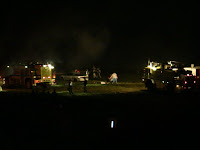
The post event wrap-up of our full-scale emergency exercise, we're pleased to say, is a positive one! On Saturday evening, 9/18 at 8 pm we we conducted our exercise as required by the Federal Aviation Administration. The exercise was executed by 108 emergency personnel from the community, 75 volunteer victims, and 40 airport and airline personnel.

The 108 emergency personnel included fire, police and EMS from York, Dauphin and Lancaster counties. These personnel joined forces with airport fire and police personnel to rescue 75 volunteer victims, 13 adult dummies and 2 infant dummies in a simulated plane crash on the east end of MDT's runway. The victims and dummies were assigned varying degrees of injury and had to be treated accordingly by the first responders.

The participating fire, police and EMS included 33 apparatus from Lower Swatara Township, Middletown, High Spire, the PA 193rd Air National Guard, Londonderry, Steelton, Swatara Township, Hershey, Union Deposit, Bainbridge, Fairview Township, DESSP, Life Lion, Hershey, Northwest, Manheim Township, and Community Life team. Other participating agencies were Emergency Health Service Foundation, American Red Cross, Dauphin County coroner, Dauphin County Communications and the PA 193rd Air National Guard Airfield Management Security Forces.

As you can see a LOT of time, effort and personnel went into exercise. In a matter of 90 minutes these combined community efforts provided scene safety, assessment, victim treatment, transport, fire fighting, and many other activities in an effort to build team skills in the event that an actual emergency incident would take place on the airport campus. These concerted efforts made this exercise a success!

MDT would like to extend a huge THANK YOU to all of the participating agencies, personnel and volunteers that helped make this exercise happen. We would also like to thank you, the community for staying up-to-date on the exercise as well!

You can read through our archive of live tweets during the exercise and also view photos of the exercise.

20.9.10

Post Exercise Wrap-Up

Please accept our apologies for the wrap-up post delay, as we're still collecting a few informational pieces to put together a robust piece together for you on the full-scale emergency exercise from 9/18/10!

We'll go live with our final blog wrap-up tomorrow! Stay tuned!

18.9.10

An Intro to HIA's Full-Scale, Emergency Excercise

This evening (9/18/2010) beginning at 8 pm, Harrisburg International Airport, along with local emergency responders, will be conducting an FAA required full-scale, emergency exercise. We expect that the exercise, held on the airport campus, to be wrapped up by 12 midnight. Local residents, guests and passengers at HIA will see lights and hear sirens during this time, as HIA and airline employees, along with the local responders simulate and respond to a staged emergency aircraft incident. Anyone seeing or hearing any part of the exercise should not be alarmed, this is ONLY an exercise!

Emergency Exercise FAQ

So what's the point of an airport conducting an emergency exercise?
The goal of the exercise is to enable airport and community fire, security, medical,and other resources to join in an effective, coordinated response to airport emergencies.

How often do you have to hold an emergency exercise?
The FAA requires the exercises to be conducted every 3 years.

What do you do at the emergency exercise?
In the months prior to the emergency exercise taking place a oversight team at the airport decides what type of emergency incident will be simulated/practiced at the exercise. The type of emergency being practiced is then planned for, and then simulated on the day of the exercise. Types of incidents that are practiced varies from year to year and from airport to airport.

Who participates in the emergency exercise?
Fire, police, dispatch, EMT, paramedic, airport personnel, airline personnel participate in the exercise, along with a number of their friends/family as volunteers.

What do the friends/family volunteers do at the exercise?
These volunteers will pretend to be "victims" of the type of emergency incident being practiced at the exercise. They are often dressed with make-up and paint called "moulage" to simulate different types of injuries that may/might be received in a real event.

How do you determine if the participating parties have learned what they are supposed to?
At the close of the exercise, the parties involved meet for a debriefing meeting wherein a group of people that had been selected to observe the exercise share their observations. All aspects of the exercise are discussed and performance rated. The goal of the exercise debriefing is to make sure all parties involved know what went well and what aspects needed improvement.

What other questions do you have? Post them as a comment and we'll be happy to answer them! The FAA provides a full airport exercise guide, feel free to take a look.

We will be covering the exercise with live social media coverage as it unfolds, so stayed tuned to Facebook and Twitter for live updates!

And tomorrow we will publish a post-exercise wrap up blog post!

10.9.10

Are you a Social Air Traveler?

When you cruising through the terminal looking for your gate, you may notice that many of your fellow air travelers are engrossed in their smart phones, iPads, netbooks, laptops, or any number of other electronic handheld devices. Some of those travelers may even be occupied by multiple smart devices. What are they doing? They're emailing, uploading, downloading, texting, tweeting, posting, writing, compiling, computing, researching, reading, surfing, sharing, shopping, and the list of activities is endless! Did we miss any?

Each day more and more of these activities are becoming socially connected to those around us. We have ever increasing opportunities to share what we're doing with just about everyone that we're connected to through social networking sites. This revolution in how we participate in online activities makes us social at work, play, travel, life, and more. How are you connecting with your Social Graph?

If you are traveling alone, do you connect online via social media to keep in touch with your family and friends? If you're traveling with a colleague on business, do you converse over the web or over a cup of coffee?

How do you prefer to be social when flying?

19.8.10

Time for another $250 Facebook Giveaway!

Hey fans, followers, friends, subscribers, tweeps, and social media community! We've put together another giveaway just for you! What's the scoop you ask? Our Facebook fan page has been seeing weekly increases in fans joining the HIA social networking community and "liking" what we're doing and we're super appreciative. To show just how much we appreciate our fans we're giving away a $250 airfare gift certificate when we reach 2,000 fans. At that point out, our fans* become eligible for the giveaway.

The gift certificate is good toward airfare on an airline of your choice. The trip must originate or end at HIA. So if you live out of the area, but are planning on flying into HIA you could employ the gift certificate toward your trip! But, it doesn't stop there... if we reach 3,000 fans we'll do a 3rd giveaway of another $250 airfare gift certificate!

This is one of the ways we'd like to thank you for your continued support of our social networking community and the airlines serving HIA! Did you know that you can connect with our social networking community from our website? Be sure to let us know what you think of the new integration!

*If you are an employee of Susquehanna Area Regional Airport Authority, tenant or an airline serving SARAA/HIA, you and your immediate family members are not eligible for these giveaways.

14.7.10

More than Just Planes : Fleet Maintenance at HIA

On any given day at Harrisburg International Airport (HIA) there are more than airplanes, ticket agents, and baggage handlers operating to make sure passengers get to their final destination. There are large numbers of people and machines required to make an airport work. If you take pause for a moment you will find everything from trucks and heavy equipment to tractors and lawn mowers to police cars and fire apparatus working hard on airport property. The trucks transport airport maintenance staff, and support equipment around the property to make sure the airfield and facilities are in working order, the snow removal equipment clear the snow from the airfield during winter storms so aircraft can land safely and efficiently, the tractors and lawn mowers keep the landscape around the terminal manicured and grass near the runway neatly clipped so that aircraft crews have a clear view of the runway. Police vehicles patrol the property to keep safety and security a top priority at HIA and shuttle buses get you from the parking lot to the terminal front door in a timely fashion. There are approximately 220 various pieces of equipment and vehicles in the airport fleet that require periodic maintenance or repair. This fleet does not include the aircraft, luggage tugs, and other miscellaneous equipment used by the airlines.

With such a large fleet of equipment and vehicles working hard all year long, parts and pieces are
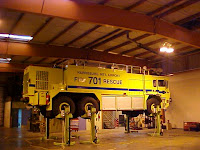
bound to require upkeep and maintenance. HIA has a staff of 3 qualified technicians in our fleet maintenance department that are well-trained to keep those 220 fleet members in working order. The technicians include Bill, Joe and Bob combined the guys have approximately 90 years of combined mechanical experience in fleet and vehicle maintenance. They share knowledge of vehicle emissions testing and repair, vehicle maintenance inspections, hydraulics, diagnostics, engine electronics, vehicle safety inspections, vehicle restoration and routine maintenance, metal fabrication and welding, air conditioning testing and repair, and many other areas of expertise. All of these skills and certifications allow the team to maintain a piece of equipment as small as a weed whacker and as large as the aircraft fire fighting vehicles owned by HIA.

The HIA owned equipment is maintained almost exclusively on site by our fleet maintenance department. The maintenance team pride themselves in doing as much as they physically can in the maintenance facility located on airport property. Team manager, Bob, indicated that they rarely send work out, but if they must it’s usually a job requiring specialized knowledge and equipment, for example, heavy engine work or an automatic transmission rebuild. The guys are routinely up for a challenge though; they have a myriad of training courses available to them from vehicle and equipment manufacturers. These training courses assist the department in staying technically and technologically up-to-date. Bob pointed out, that while you cannot always upgrade to brand new equipment and vehicles, you can add to and modify the existing fleet. The team’s ability to remain creative and proactive is a standard operating procedure everyday.

The ultimate goal of fleet and vehicle maintenance is to maintain all equipment in a continuously safe state of operational readiness in order to keep the airfield and facility operations supported. Did you know in the winter months that HIA has a fleet of specialized snow removal equipment that, at times, needs to work around the clock to keep the airfield clear of snow, sleet and ice? If one of these vehicles breaks down, it’s up to Bill, Joe, and Bob to get it back in working order. Many of the snow removal vehicles are custom built and require highly specialized parts in a timely fashion. By design, the guys are prepared and keep an inventory of parts in stock, and can get a vehicle back into the snow removal rotation in a snap! For example, the brushes on the high-speed runway brooms machines that are used in snow removal wear out from continuous use in heavy snow. The truck can be pulled into the shop, brushes changed out, and the truck returned to the rotation in less than 90 minutes. How’s that for efficient? That kind of quick turnaround in vehicle maintenance lends itself to your flight landing safely and on-time at HIA in winter weather. The department continuously plans for efficiency of operations regardless of the weather conditions.

When asked what were some of the more unusual vehicles they’ve worked on as a department, Bob indicated that the specialized snow removal equipment is pretty unique in it’s size and sophistication, but that the most unique items we have worked on were the Segway Human Transporters that HIA police formerly employed to patrol the interior of buildings. He also pointed out that the air traveling public might not realize that the jet bridges used to board an aircraft are also part of the equipment maintenance responsibilities. Someone needs to make sure that the wheels and other features of the jet bridges work properly!

Does this sound like a career that would be interesting to you? Bob said that specialized training, certifications and on-the-job experiences the team has learned along the way does not normally come from a traditional college education. With the technology exploding in the industry, ongoing training and accrued knowledge is never ending. Their team has a great culture; they all have differing strengths and weaknesses, but they all care about the equipment in the fleet to the point of knowing the individual character of each piece. Their mutual respect for the equipment combined with their differing expertise allows them to cooperatively take on nearly any task with great success!

“Individually we are limited but together we are limitless!”

What unusual pieces of equipment or vehicles have you seen on the airfield when you've flown to/from HIA? Which of the types of equipment or vehicles mentioned would you like to know more about?

13.7.10

Beat the Heat: Summer Travel Tips

This time of year is known for abundant sunshine, high temperatures and depending on where you are, very dry or very humid days. We've put together recommendations for your consideration for when you're throwing things into your suitcase, when you're on the plane, or at your sunny final destination!
  • Pack light: If you're heading to a sunny destination, be sure to pack clothing that is light colored and light weight. Darker colors attract more of the suns rays and heavier materials will keep your body heat trapped in longer. So avoid the these types of clothing if you can!

  • Defend your skin: Don't hesitate to bring your sun screen and remember to apply, apply, and reapply. Even if a sunscreen self-advertises as waterproof, it will eventually wear off after multiple dips in the ocean or pool, and you can sweat it off too! It's better to safe than sorry, so keep your dermis safe and sunburn-free.

  • Protect your eyes: Sunglasses or a hat with a brim are both great ways to keep the sun out of your eyes. The added benefit of a brimmed hat? An additional way, in combination with sunscreen, to keep the sun off your face!

  • Drink up: Keep yourself hydrated! Water is a good option, but if you're sweating profusely you may wish to consider drink options that are rich in electrolytes to replenish the sodium and potassium your body's lost. Sport drinks, like Gatorade or Powerade, are a good option for electrolyte replenishment.

  • Respect your limits: Yes, you want to see everything that you possibly can when traveling, but your body will tire out quicker in the heat. If you're feeling sluggish, flushed, or warmer than usual, take a break, find some shade or a cool indoor environment, and hydrate!

  • Keep kiddies cool: All of the aforementioned tips apply to the littlest of travelers also!

  • Mind Fido too: Don't forget that heat is hard on animals. If you're traveling with a pet, keep it hydrated and don't work/play/run it too hard. Dark-coated animals mind the heat more as their fur will absorb more of the suns rays.
Do you have tips to add that we've missed? Do you have recommendations for those traveling with small children and/or pets that you've found to make the trip more tolerable?