Showing posts with label aviation. Show all posts

14.5.12

#MDT324 from @User47

MDT hosted our second annual fly in tweet-up, #MDT324 and over the course of the next week or two will be sharing the blog posts from the attendees.   Attendee JLJ was a first time attendee.  JLJ astutely self-describes as a Biz Analyst. INTJ. Pescatarian. Info sponge, #avgeek. I love: @JLJ_2, NPR, documentaries, #planespotting, travel, wildlife, sci, tech, #photog and root beer.


JLJ shares, today, about his experience at #MDT324:


My friends tell me I’m a nut. You see, at least twice a year I take a three to four-day weekend for the sole purpose of planespotting, trying out a new airline, adding lines to my flightmemory, flying just to fly, or in most cases, some amazing combination of these. It turns out there are lots of folks out there like me, avgeeks, propheads, milerunners, aerophiles, really, it’s all the same. We are folks who love everything about aviation. Planes, airports, runways, airlines—We love ‘em all.

My most recent aviation-themed weekend involved a multi-legged trip to and from Harrisburg International Airport for a small tweet-up, that is, a meet up of tweeters/twitter-ers hosted by the airport. The second annual MDT tweet-up, affectionately dubbed #MDT324 as a throw-back to the first event’s date, involved a tour of the airport’s secured and non-secured facilities to include the administrative offices, baggage handling operations, common areas, and my personal favorite, the tarmac apron where commercial, private and military traffic could be seen just yards away.

The tour ended with awards of swag-bags, containing an assortment of goodies and an incredibly complex (designed for ages 6-12) LEGO aviation set. We spent a good 45 minutes or so racing to build our airplanes, but we all basically ended up with duds. I’m sad to report that my blatant disregard for the instructions coupled with my terrible design skills “won” me the least defined, least likely to fly hodge-podge of plane parts. All I really needed to complete my hybrid plane to nowhere was some speed tape, the aviation industry’s answer to duct tape.

My visit to MDT was delightful and exceeded expectations. It's clear that the airport leadership wants to build a facility with passenger experience and comfort in mind. As a matter of fact, I can honestly say that all but one of the people I met who were employed directly or indirectly by the airport, its vendors or airlines were genuinely happy, an odd and terribly uncommon phenomenon. The exception? A single TSA agent, there's always one, isn't there? I don't see this as a negative, though. Because of all the TSA staff I encountered, all but this one were, like the others, genuinely happy.

As a Business Analyst by trade, I'm always considering how organizations can build upon what works and address what doesn't. Comparing the strategy and operations of one company to its industry-peers, and finding pros and cons is what I do for a living. And, while I'm not in any way involved in the aviation business, I cannot seem take off my continuous improvement hat while traveling or on holiday.  Strolling through the airport terminal prior to our meet-up I was able to check everything off of my list of need-to-haves and nice-to-haves for the perfect airport, this was a fist for me. I won't share my list, because the contents aren't important. What I will share is that I generally add one or two things to my list when I visit a new airport, with this visit not only did I check everything off, I added three.

We concluded the evening with dinner at a restaurant just off of the Lancaster Airport’s tarmac. I could write an entire blog just on that experience, but suffice it to say, it was an excellent way to end a busy and exciting day. Planespotting at sunset over great food and excellent conversation, it doesn’t get much better than that.

#MDT324 is an event designed to cater to the most extreme and dedicated aviation enthusiasts, or "avgeeks."   We look forward to meeting some newbies and seeing the old crew at next year's event!

7.5.12

The Power of Curiosity

MDT hosted our second annual fly in tweet-up, #MDT324 and over the course of the next week or two will be sharing the blog posts from the attendees.   Attendee Mike Morgan visited us for the event for a 2nd year in a row.  A little about Mike: He loves to fly.  He became a passionate #avgeek when he lived in Orlando and watched planes for hours at ORL.  He self-describes as being obsessed with Boeing, Marriott, United, and Taco Bueno. He is working towards a private pilot certificate and mostly flies in a C172.  He hopes one day to own his own airline, and proudly fly an all Boeing fleet.

Mike shares, today, about his experience at #MDT324:


Friday, April 20th started just like any other normal Friday for me.  Wake up early. Take a shower.  Fumble out of my Marriott hotel room.  Find my rental car.  Drive to some airport.  TSA.  Board.  Fly.  


But, my destination would not be home on this Friday.  After a two hour layover at EWR (Newark, NJ), I hopped on a Bombardier Q200 and flew at 8,000 feet to MDT.  It was time for the second annual #MDT324 tweetup! 


At 3:24pm we all met up to spend some serious time in #avgeekery.  @airport_girl, Stephanie Gehman, Harrisburg's Marketing Manager, treated us to a behind the scenes look at the airport.  Stephanie had lego airplanes for us to build (needless to say, Boeing won't be hiring us as engineers any time soon).  We also took an airport quiz (Did you know that there are 4,200 window panes in the airport?  Also, the apron takes up 45.1 acres.). Then we headed to dinner.  Among us were @airport_girl, @BruceBere, @user47, @GehmanAndCo, and myself.  I have met each of these great people at other airports around the country.  


Here's what made this year's #MDT324 so amazing.  We had a real conversation about the good that plane spotting offers.  @user47 is an avid plane spotter, and he works hard educate others that plane spotting isn't doing any harm.  We ate dinner at a restaurant that sat next to the ramp at another airport.  While we were talking a little girl ran up to the fence to take a picture of a plane passing by.  @user47 said, "That's why plane spotting is good."  And he was right.  Plane spotting encourages people to learn about engineering, physics, and it's even pushed me to learn more about business!  


How many of you first watched a plane fly over head and thought, "I wonder how that giant hunk of metal stays in the air?"  Maybe you watch planes at a hub and ponder what it takes to manage all of that.  Plane spotting encourages curiosity.  It causes people to learn and grow.  The airline industry is treated like a bus service for potential terrorists, but should be regarded as an industry that makes the impossible possible.   


Plane spotting builds community.  Look at the folks who spot together with NYC Aviation, and other like groups.  MDT offers an observation deck at the airport, and with visitors like Air Force Two it's well worth the trip (so book a round trip to MDT, you need the miles anyway!).  My hope is that other airports will catch on and start to encourage the love of aviation, and stop trying to ban those of us who are passionate about it.  


This was my second year to #MDT324, and once again I am very thankful for the opportunity to join my #avgeek friends.  I am already planning next year's trip!  I would really like to thank Stephanie and the Harrisburg International Airport for their hospitable spirit towards #avgeeks. 
But, hey, I'm just some guy who likes to look at airplanes, so what do I know?


We look forward to having another crew of #avgeeks fly in for next year's #MDT324!  Hope to see you there, Mike.


The thoughts shared in this post are those of the author and don't represent the viewpoints of Harrisburg International Airport.

30.4.12

#MDT324 - @BruceBere


Bruce Bere
MDT hosted our second annual fly in tweet-up, #MDT324 and over the course of the next week or two will be sharing the blog posts from the attendees.  Today's post is from Bruce Bere, a self-described 'airline, aviation and travel enthusiast' from the Midwest.  This was Bruce's first time joining us for fly-in tweet-up.

I love aviation—quite a bit. When I got an email and an invitation to the tweet-up, #MDT324, I jumped at the chance to go. Flying in from all different areas of the country, a group of people met at HarrisburgInternational Airport (MDT) and started what was the second consecutive tweet-up for this group.

Our lovely host, Stephanie Gehman (@airport_girl), who showed us around the airport including a behind the scenes look at the baggage operation and the tarmac, met us. Working for United Airlines at ORD, it was quite an experience to see a completely different airport. I am used to a baggage room with over 100 belts for different flights--MDT has only three. Overall, it was a great experience getting to compare a larger and smaller airport. The neat thing about MDT was the fact that so much goes on there that I certainly would never have guessed before touring the facility. Between the commercial aviation, military presence, and the FBO on site, it is always a full day.
Going into the tweet-up, I was a bit uneasy. I am shy by nature but by the end of the night, I felt great connecting with such a great group of people. Here’s to #MDT324 2013! 

We look forward to having another crew of #avgeeks fly in for next year's #MDT324!  Hope to see you there, Bruce.

26.3.12

The Beginnings of MDT (1917-1969)

David Vanderhoof, Aviation Historian
We'd like to introduce, David Vanderhoof, an avid aviation historian from here in Pennsylvania that graciously agreed to guest blog a 2-part series on the history of Harrisburg International Airport (MDT), also known as HIA.  David maintains an interesting historical blog and a podcast due to his love of aviation.


Many of you may be familiar with David as one of the hosts and commentators on the popular aviation podcast, Airplane Geeks!  On the weekly podcast David shares his bits of aviation history with the audience.  Today you're his audience as we begin part one, enjoy! 

Harrisburg International Airport is located on the Susquehanna River.  It has had a long history with aviation as well as a long runway! 

But why does the tag on my bag say MDT when I am at HIA? 

The story of HIA starts in 1917 with the United States Army Signal Corps adding an airfield to the Middletown Facility.   The Signal Corp actually had been on the site since 1898.  Next to supply depot, a grass field was put in place.  By 1918, the first aircraft were landing and taking off at Middletown Airfield. Curtis JN1s or Jennys filled the field.  The Middletown facility became a strategic supply depot supporting the U.S. efforts in World War I. Machine shops for engines and woodshops for fuselages.  Fabric for wings.  A nest for the fledgling air service.  The base continued its work post war.

In 1922, the United States Army Air Corps (USAAC) was formed and one of its most important bases was the Middletown Air Depot.   During the thirties, it continued to grow and add more warehouses and storage facilities.  Eventually the Middletown Airfield became the Olmstead Army Airfield. 

Olmstead AAF was named after 1st Lieutenant Robert Stanford Olmstead who was killed in the line of duty.  Olmstead was an accomplished aeronaut, and the U.S. Army entered the Army Balloon S6 into the prestigious 1923 Gordon Bennett Cup.  The Bennett Cup was, at the time, equivalent to F1 or NASCAR Racing.   The ’23 race was a nightmare due to the weather.   Olmstead and his partner, 1st Lieutenant John Shoptaw, launched and were immediately thrown by wind into another unlaunched Belgian Balloon the Ville de Bruxelles.  The Belgian’s netting was cut by the S6’s gondola and couldn’t take off.  The S6 seemed to be ok, and Shoptaw  and Olmstead climbed into darkened thunderclouds on September 23, 1923.  After surviving the harrowing takeoff, the S6 and its crew were struck by lightning three hours later.  The Balloon and gondola caught fire and crashed near the town of Loosbroek in the Netherlands.   Neither Olmstead nor Shoptaw survived the crash. 

Olmstead Army Air Field was, again, another strategic base during the conflict in World War II.  Numerous Transport and Reconnaissance squadrons arrived at Olmstead AAF to pick up their aircraft before heading to the European Theatre of Operations.  If you looked at the flight line in 1943, you would see C-47s, C-54s, and all sorts of P-38s and P-51s. 

After the war, the base continued to be a facility with strong ties to logistics.  In 1947, with the creation of the United States Air Force, the facility again changed its name to become Olmstead Air Force Base. 

Olmstead became a hub for supplies and made a serious contribution to OPERATION VITTLES, the airlift during the Berlin Blockade.  While not actually providing the food shipments, Olmstead provided the support for the transports making the runs.  Engines, overhaul equipment fuel supplies all the necessary logistics to support a major airlift.  They also served as the depot for all the medical supplies sent to support the mission.  During that time, much of that was airlifted, was by the 64th Troop Carrier Squadron flying Curtis C-46 Commandos.

For the remainder of the 50’s through to the late 60’s the base remained part of the Air Force Logistics Command  (AFLC) and was the prime support base for the Northrop T-38 Talon and the L-27/U-3 “Blue Canoe”.  These were two very important aircraft that trained and supported the modernizing USAF.

In order to reduce costs due to the on going Vietnam War, a decision was made by the Pentagon to inactivate the facility. This became effective June 30th 1969.   The base was transferred over to the Pennsylvania Air National Guard.  Thus changing from Olmstead Air Force base to Olmstead Air National Guard Base.   

In Part II, we will focus on the 70’s through to the current times.

Thanks for reading along on our historical MDT journey.  What questions might you have regarding the facts that David shared in his post?


Works Cited
Francillon, René J. The Air Guard. Austin: Aerofax, 1983. Print.
"Harrisburg Air National Guard Base." Wikipedia, the Free Encyclopedia. Web. 03 Dec. 2011. .
Jackson, Donald Dale. The Aeronauts. Alexandria, VA: Time-Life, 1980. Print.
p144-145
Vaeth, J. Gordon. They Sailed the Skies: U.S. Navy Balloons and the Airship Program. Annapolis, MD: Naval Institute, 2005. Print.
Williams, Nicolas M. Aircraft of the United States' Military Air Transport Service. Leicester: Midland Limited, 1999. Print.
"The WILMER LOWER STULTZ Page of the Davis-Monthan Airfield Register Website." Welcome to the Website of the Davis-Monthan Airfield Register. Web. 03 Dec. 2011. .

25.1.12

Aircraft of our Lives: Pilatus PC-12NG

We will be running occasional posts in a guest series entitled "Aircraft of our Lives," featuring the favorite aircraft of pilots from around the globe.  Today, Jean Denis Marcellin, a professional pilot for a major Canadian operator, shares with us his love of the Pilatus PC-12NG.  Jean Denis is interested in helping make the world a better place for his fellow pilots and is passionate about aviation and all things that fly!  Enjoy today's flight on the PC-12NG. 

So the crew fly on with no thought that they are in motion. Like night over the sea, they are very far from the earth, from towns, from trees. The clock ticks on. The dials, the radio lamps, the various hands and needles go through their invisible alchemy. . . . and when the hour is at hand the pilot may glue his forehead to the window with perfect assurance. Out of oblivion the gold has been smelted: there it gleams in the lights of the airport.
— Antoine de Saint-Exupéry, 'Wind, Sand, and Stars,' 1939.

I often relate to Saint-Exupéry because flying has always had this ‘magic’ feeling for me. Maybe it was because of reading his masterpiece ‘’Le Petit Prince’’ when I was only a boy, sharing the Prince’s awe for this strange pilot and his wondrous bird. Or maybe it was just a plane love story… but I knew it was only a matter of time before I made my own way to a cockpit. And so it was that when it came time for college, I had the amazing opportunity to complete my flight training through one of Canada’s most highly regarded aviation colleges – le Centre Québécois de Formation Aéronautique (http://www.cqfa.ca).

Acquiring my CPL and Twin-IFR there during a 3-years program, I went on the International Air Rally the summer I graduated. Crossing the Quebec province from all possible angles, the 20+ airplanes involved went from Montreal to Iqualuit, ending the trip back near Quebec City. What a blast! This opened doors, created connections, and led me to my first job in Toronto, flying charter flights in a Piper Chieftain. It was a fun airplane – a real work horse – but nothing compared to what came next!

Today I fly a Pilatus PC-12NG, doing medical evacuation missions across the province of Ontario. Although it is ‘only’ a single-engine turbine, this airplane will never cease to amaze in every way.

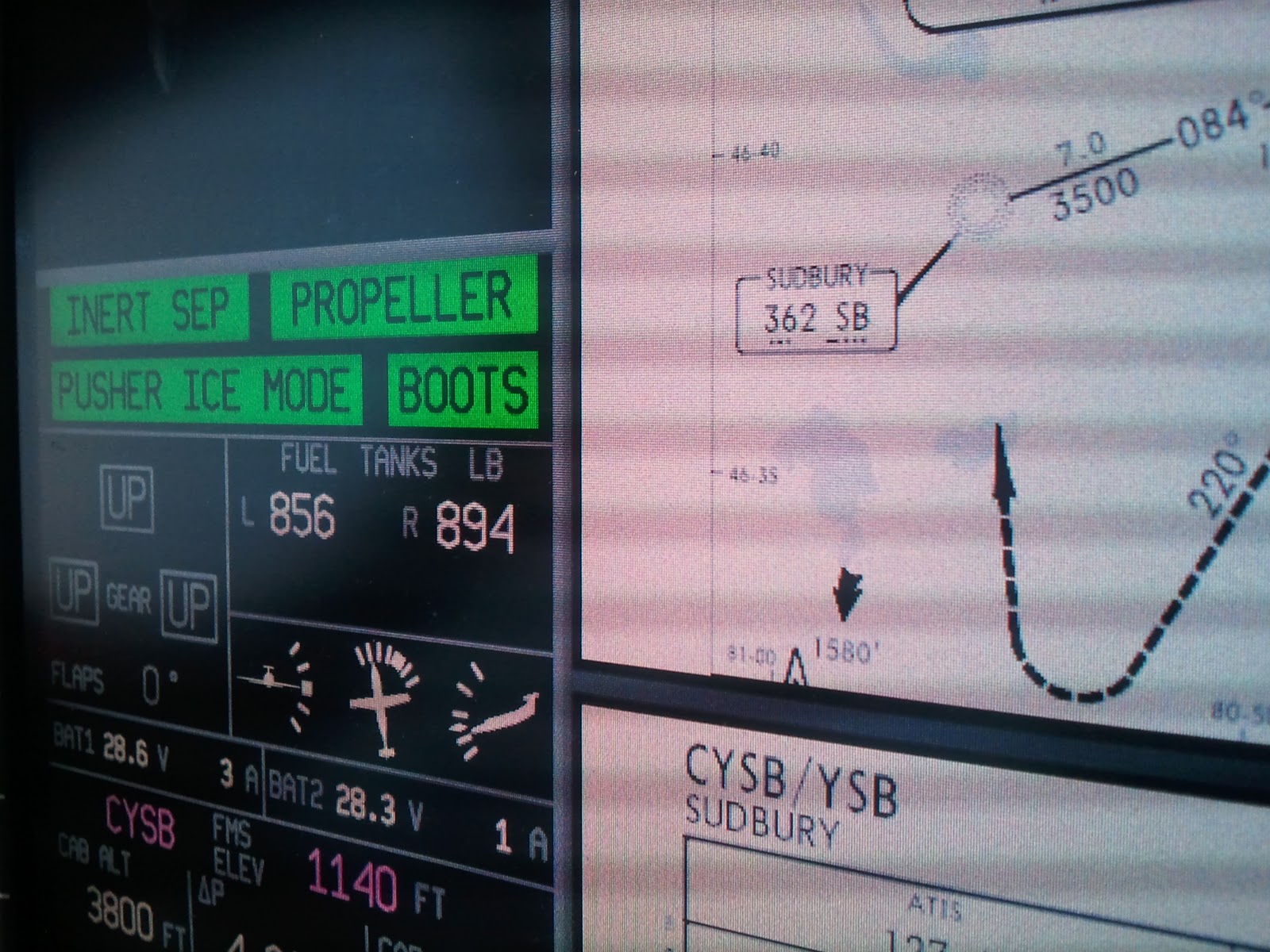
A recent example of what the aircraft is capable of would be my last recurrent training ride. It always starts with the push of a button – the automated system taking it from there, starting up electrical systems one after the other in sequence when the engine parameters reached their pre-set values.  The goal of the flight: test our capability to handle the aircraft – both in technical flying exercises as well as IFR procedures. Piece of cake! As we roll out from our hangar and start our taxi, the tasks are divided into configuring the aircraft for take-off and setting up the ‘FMS’. A wrong flaps or condition lever setting will own you a vocal warning from the aircraft: a loud ‘NO TAKE-OFF’ for all  to hear in the aircraft, making sure you will be so  embarrassed that you won’t miss it next time! The FMS incorporates all the legs of the flight, allowing the pilot to enter everything from the departure runway, SID, enroute airways, STAR and approach. Once all the information is in, it calculates a vertical profile and announces forecasted fuel consumption.

“Radio, Pulse 101 on the roll, Runway 03”. With that announcement, and all the checks complete, the last thing left to do is set the power. The PC-12NG boasts 1600 SHP, de-rated to 1200 SHP. You can definitely tell it yearns to fly. “Set Take-Off Power” the captain calls. “Take-Off Power Set” I answer.  Picture me jumping around in my seat with ELEVATION by U2 rocking in my head. It never fails. With that, I call “Positive Rate of Climb” and “Gear Up”. We are in business!

Quickly reaching our cruise altitude for today – a cozy 16,000 feet – we setup in cruise and prepare for some technical flying prowess. Ok I may be exaggerating. The airplane deserves most of the praises here, as the exquisitely crafted ailerons and trims take care of perfectly balancing the flight controls in the pilot’s hands. Only smooth movements are required as we roll through steep turns, stalls, and finally simulated engine out procedures.  Now onto the fun part!

Rapidly approaching the airport once more, we request an ILS approach, followed by an overshoot and a transition into another approach. Darn! As we near the beginning of the first approach, we get reminded that we also need to complete a holding procedure. No worries, the FMS has it all under control! Entering our first approach into the FMS and loading up the electronic approach plate that goes with it, the captain and me make a quick work of briefing and finally starting the approach. “Minimums – NO Contact” I announce once we reach our simulated minimum altitude. With the simple push of the “Go-Around” button, the Captain switches the FMS onto its overshoot procedure, synchronizing navigation and altitude constraints to reflect the new flight path already loaded. Smoothly applying full power once more, we climb out with no more to do than let ATC know we are back with them  for the next approach.

We still have to complete a holding procedure. But where? The airplane does not care, as it can enter a hold virtually anywhere, from any direction, by itself. So the task falls on me to decide as it’s going to be my approach. “Let’s ask ATC for a hold at our FAF, following the DME-ARC in” I decide.  But ATC throws a wrench in our well-laid plans. “Pulse 101, there is company traffic inbound with MEDEVAC priority. Maintain present radial to intercept the DME-ARC inbound, then you are clear to hold at the FAF as published. Report established in the hold”. I must admit I lost my breath trying to read back the clearance. WHAT sort of intercept is THAT going to give us? Looking at the captain, I see the same question mark in his eyes. Time to see what this computer is capable of! Swiftly entering the full approach and DME-ARC in the FMS, I setup the airplane to intercept from our present heading. 30 seconds later, the hold is also programmed and we still have a few minutes to take a breath and finally brief the procedure. Both the captain and I sit back, and monitor as the airplane intercepts, flies the arc, then enters the hold – all on its own. Never ceases to amaze!

Finally leaving the hold for the final stretch, I ask the captain to take a quick look at the wings as we are descending through icing and good winds. The approach will be the most challenging part of the day. With the de-ice system working full time, I make my way down the localizer steadily. Because of gusty cross-winds, I brief for a slightly higher reference speed over the threshold. The airplane has advanced stall protection which is not forgiving – a stall during flare would still activate the stick-pusher, ending with a hard nose-wheel at best…

“500 Hundred” – the automated callout resonates through the cockpit, informing us of the rapidly approaching runway. “Ref plus 10” my captain calls out. The last few hundred feet give us a rocky ride as the winds push us from side to side with each gust. I flare with a low wing into the wind, waiting for contact. I feel it – ever so slightly, as the trailing-link design of our main wheels absorb most of the touch-down shock. Bringing the power to full reverse, I settle us back firmly onto the runway.  “Radio, Pulse 101 is down and clear”. Another day, another flight. One always amazing airplane! 

9.8.11

Aviation Field Trips for the Young & Young at Heart


Our Facebook fan page wall is a great place to crowd source the answers to many questions.  We know that many of you L-O-V-E to travel and be a tourist.  So we took the opportunity to ask our fans where they found to be the best spots for an aviation-themed field trip.  We were so pleased with the response!  

Looking for a great place to check out aircraft in your local area, or perhaps a new place to plan a trip to?  Well why not plane spot at these fantastic locations?  This list is not comprehensive and is in no particular order, but certainly includes some thoughtful recommendations from MDT fans: 

Wright Memorial
(Kittyhawk, North Carolina)
Wind, sand, and a dream of flight brought Wilbur and Orville Wright to Kitty Hawk, North Carolina where, after four years of experimentation, they achieved the first successful airplane flights in 1903. With courage and perseverance, these self-taught engineers relied on teamwork and application of the scientific process. What they achieved changed our world forever.

As the second busiest airport in the Caribbean after Puerto Rico's San Juan airport, St. Maarten/St. Martin airport serves as a gateway to the Lesser Antilles as well as an alternate route to the British Virgin Islands. And, given its famous dual French/Dutch personality, this fabulous destination is itself well worth at least a mini-vacation on its own.


Air Force Museum (Dayton, Ohio)
The National Museum of the United States Air Force galleries present military aviation history, boasting more than 360 aerospace vehicles and missiles on display -- many rare and one-of-a-kind -- along with thousands of historical items and powerful sensory exhibits that bring history to life and connect the Wright brothers' legacy with today's stealth and precision technology. We invite you to take an online glimpse of our galleries. Click on a gallery name to see exhibits, including aircraft, engines, equipment and weapons of the USAF. The section also highlights special exhibits, current exhibits and restoration projects.


Carolinas Air Museum (Charlotte, North Carolina)
The museum is conveniently located adjacent to Charlotte Douglas International Airport, so your visit will include watching all types of commercial and private aircraft land and takeoff.  The excitement of feeling the power of the big jets taking off is sure to be an experience all visitors will remember.


Museum of Aviation (Warner Robins, Georgia)
The summer is in full swing, and it’s the perfect time to visit the Museum of Aviation with vacationing visitors and your family. 
Guided tours are available and geared for people ages 5 to adult. They require a minimum of 10 people. The tours are history-based and led by the trained staff of the museum’s education department.

Museum of Flight (Seattle, Washington)The independent, non-profit Museum of Flight is one of the largest air and space museums in the world, attracting more than 400,000 visitors annually. The Museum’s collection includes more than 150 historically significant air- and spacecraft, as well as the Red Barn®—the original manufacturing facility of The Boeing Co. The Museum’s aviation and space library and archives are the largest on the West Coast. More than 100,000 individuals are served annually by the Museum’s on-site and outreach educational programs. The Museum of Flight is accredited by the American Associations of Museums, and is an affiliate of the Smithsonian Institution.

The Mighty Eighth Air Force Museum preserves for all Americans the stories of courage, character and patriotism displayed by the men and women of the Eighth Air Force from World War II to the present.

The Mighty Eighth Air Force Museum’s vision is to sustain our cultural heritage, support lifelong character education, and to be a center of community engagement.

EAA AirVenture (Oshkosh, Wisconsin)
For 51 weeks a year, EAA is an international community of more than 160,000 members that nurtures the spirit of flight through a worldwide network of chapters, outreach programs, and other events.

But for one week each summer, EAA members and aviation enthusiasts totaling more than 500,000 from more than 60 countries attend EAA AirVenture at Wittman Regional Airport in Oshkosh, Wisconsin, where they rekindle friendships and celebrate the past, present and future in the world of flight.

Museum of Naval Aviation (Pensacola, Florida)
Fly high with an adventure at the National Naval Aviation Museum, one of the world’s largest aviation museums. Located aboard Naval Air Station Pensacola, this historic treasure boasts more than 150 beautifully restored aircraft, hands-on exhibits and more than 4,000 artifacts representing Navy, Marine Corps and Coast Guard aviation. Watch the awe-inspiring Blue Angels at practice air shows from March through November, take a ride in a motion-based or Top Gun Air Combat simulator, have fun with the ultimate seven story giant screen movie experience in the IMAX Theatre and dine in the Cubi Bar Café, an exhibit itself. There are plenty of family-friendly ways to get the most out of quality time with the kids.

Free admission is an added bonus, as well as free tours inside the Museum and on the flight line.

Udvar-Hazy Center (Washington, DC)
The Steven F. Udvar-Hazy Center near Washington Dulles International Airport is the companion facility to the Museum on the National Mall. The building opened in December, 2003, and provides enough space for the Smithsonian to display the thousands of aviation and space artifacts that cannot be exhibited on theNational Mall
. The two sites together showcase the largest collection of aviation and space artifacts in the world.

Aircraft Graveyard (Tuscon, Arizona)
The Pima Air & Space Museum offers exclusive bus tours of the 309th Aerospace Maintenance and Regeneration Group (AMARG), also known as the "Boneyard." The facility is located adjacent to the Museum at Davis-Monthan Air Force Base.
The National Museum of the Marine Corps is a lasting tribute to U.S. Marines--past, present, and future. Situated on a 135-acre site adjacent to Marine Corps Base Quantico, Virginia, and under the command of Marine Corps University, the Museum's soaring design evokes the image of the flag-raisers of Iwo Jima and beckons visitors to this 120,000-square-foot structure. World-class interactive exhibits using the most innovative technology surround visitors with irreplaceable artifacts and immerse them in the sights and sounds of Marines in action. 


CR Smith Museum (Dallas, Texas)
C.R. Smith Museum is named for the innovative aviation pioneer and former President of American Airlines, Cyrus Rowlett Smith. The building of the museum honoring C.R. Smith and his accomplishments was the culmination of a two and one-half year fundraising and building effort led by various AA employee and retiree groups. The museum opened July 3rd, 1993.
Artifacts, which began with the Paul Kent Collection, were acquisitioned, painstakingly catalogued and incorporated into the museum's displays and archives by staff and volunteers. Many of these original volunteers are still actively involved with the museum.


Have we missed any that you think should be added to the list?  Where's your absolute favorite location to plane spot and absorb aviation history?  

7.4.11

I’m an HIA #Superfan for life! - #MDT324

Over the past few months, those of you following the MDT's Twitter stream may have seen the hashtag #MDT324 in use. What appears to be a nonsensical collection of letters and numbers actually represented an event planned to bring several of our more active twitter followers to MDT for an opportunity to meet one another in person. In total 5 "tweeps" flew or drove in from across the country for an evening "tweetup" with the airport tweeter. Each tweep has graciously agreed to share their experience in a wrap up blog series.


Chris Stotz's post is the third of the wrap up series on #MDT324. Maybe we'll be seeing you at the 2012 event!

Harrisburg International Airport (HIA) is my hometown airport. I was born and raised in central Pennsylvania, graduated from Penn State in 1998, and lived in Harrisburg until I moved to Fort Lauderdale in late 2002. I remember the original Harrisburg Airport, the newer terminal in the 1980s, and I’m thrilled with the new facility. Until I moved out of the area in 2002, I was flying in and out of HIA all the time. I think the progress of HIA over the years, and what it has become today, really reflects how special and unique central Pennsylvania is. I’m so proud of what HIA has become, and it was exciting to be a part of a special event showing off HIA known by Twitter followers as #MDT324.

#MDT324 was a gathering of HIA Twitter followers from all over the United States. Stephanie Gehman, Marketing Manager for HIA, has developed an impressive online presence for the airport on websites like Facebook and Twitter. She coordinated the event with the HIA fans, and provided a special “VIP” behind-the-scenes tour of the airport. For me, it was a very special event because this state-of-the-art airport, with bright and shiny concourses, busy gates, and great vendors like Starbucks and Subway, is the kind of airport I’ve always imagined for Harrisburg and the surrounding area. It’s nice when you can return to the place you grew up and lived as a younger adult and see things going well, especially in this current economic climate. It was a great feeling to see people from around the country be impressed with what I think is the perfect airport.

In the last few years I’ve been especially lucky to be able to enjoy direct, nonstop service between Fort Lauderdale and Harrisburg on AirTran Airways. This makes it very easy and affordable to fly home and visit family and friends, with a flight time of about two hours. Lucky for me, there are many options and carriers going in and out of HIA, so getting home to central Pennsylvania will never be difficult no matter where I am. I’ve said it before, and I will say it again…there’s no place like home!

I really am proud to call HIA my hometown airport, and appreciate the opportunity to connect with HIA on Facebook and Twitter and make lasting friendships with other fans of what has become an airport that many cities would envy. Thank you to everyone involved with the #MDT324 event, and the friendly and hard working staff at HIA, especially Stephanie, for making this fly-in possible, and making HIA a pleasant and “hip” airport!

15.10.09

Where the Wild Things Are, Aviation Edition

Max was swept up and lifted high in the air...

In the spirit of the new movie, Where the Wild Things Are, opening in theaters tomorrow, we went on a hunt for the wild things that have occurred in aviation and been caught on film! These amazing and at times, crazy, feats are nail-biting, white-knuckled, heart-stopping and above all else, wild!

This pilot accomplishes a touch and go maneuver while his plane is nearly side-ways from an overbearing crosswind:


These wild stunt pilot, decides to fly under a bridge, upside down!


How about skydiving from one plane into another? Yes, a plane-to-plane stunt, midair!


Planes aren't the only aircraft prone to wild stunts! This helicopter's antics are jaw dropping. (Note: Be prepared for stereotypcial cheesy background music!)


The F-15 in this airshow video leaves the crowd with their mouth agape!


And one last video, a view of an aircraft carrier landing as seen from inside of the cockpit! (Note: Not for those prone to motion sickness)


Do you have any great aviation "wild rumpus" footage that you've caught on "tape"? We'd love to see them, feel free to embed them in your comments on this post, or email them to info@saraa.org.