Showing posts with label pilot. Show all posts

24.2.12

Aircraft of Our Lives: AS-202 Bravo

We will be running occasional posts in a guest series entitled "Aircraft of our Lives," featuring the favorite aircraft of pilots from around the globe.  Today, Etienne M. shares his about his favorite aircraft.  Etienne is an Air Traffic Controller ARR/DEP in Geneva (LSGG), Private Pilot, and fan of the New England Patriots.  Enjoy today's flight on the AS-202 Bravo.


The sun was shining on this cold December morning as I was filing my VFR flight plan from Sion (LSGS) to Lugano (LSZA). It was 2009, and I was enjoying a full month of flying in Sion as part of my training to become an Air Traffic Controller in Geneva. Skyguide, my employer, believes it is a good thing for its trainees to learn the basics of flying, and I couldn't agree more!

AS-202 Bravo
We had two AS-202 Bravos at our disposal, HB-HFH and HB-HFK. The Bravo - no connection to the Mooney M20 whatsoever -  was designed and manufactured by Flug- und Fahrzeugwerke Altenrhein (FFA) in eastern Switzerland as a trainer/aerobatics aircraft from 1969 until the early 90s. About 220 have been built, and most are still in use in flight schools. The Bravo offers two seats side by side in front, and an optional third seat in the back. Its fixed landing gear allows her to withstand some quite hard landings by the student pilots, but she is quite easy to handle, making such happenings a rarity. The Bravo behaves differently from the Cessna 172 I had flown in some previous flying experiences, so some adaptation time was required. She is equipped with a stick, and there is a throttle conveniently located on the left side of the cabin. This design proves to be very useful in the aerodrome circuit, as the pilot can fly "Hands on Throttle and Stick" very comfortably. The low-wing offers very good maneuverability while maintaining a good level of stability. The huge bubble canopy provides a great view of the surroundings, even to the rear. It really is a fun airplane to fly for training and sightseeing.

Sion airport is a wonderful place. It handles lots of GA, a growing number of business jets and a few airline flights during the winter. On top of that, it is a military base used by Swiss Air Force Tigers, Hornets and Cougars. The beautiful landscape - surrounding mountains over 10000ft high - makes it an aviation enthusiast's dream!

Bravo in-flight
This will be the first time I cross the Alps to go to the south, and I'm excited. Sion Ground clears us to hold short of Runway 25, intersection Bravo. After the run-up, we contact Sion Tower, and we are cleared for take-off. Power set, I release the brakes and the propeller drives us through the cold air: we are airborne! We climb on downwind before exiting the CTR to the east of the valley. The winter has painted the whole landscape in white, and no clouds are in sight. We keep climbing to 12500ft in order to tour the Matterhorn at a reasonable altitude. Since we are pretty heavy, the rate of climb is quite modest, and the Bravo is letting us know that we're not going to get much higher than that! The mountain appears to us in all its majesty. Its shape and surroundings are breathtaking, and it deserves to be known among the most beautiful things on this planet. It is with much respect that we wander around it for a while, before setting course to the Simplon Pass.

The Simplon Pass appears under our wings as turbulences start to make themselves felt. The Bravo is shaken quite a bit, but she keeps us bravely high above the ground. You're never too cautious when overflying a pass, as downdroughts can be pretty strong. There is a building down there, managed by Canons. You can find shelter there if you're into alpine skiing or just to find some peace away from the city. On the other side, there is Italy. I initiate the descent into the valley, and the Bravo takes advantage of gravity to accelerate a little. She definitely is not a Mooney by any means, but she's my beloved airplane, and right now, it is the most beautiful in the world. The huge canopy gives me a wonderful sight of the surroundings, and down the valley I can already see Verbania, a jewel of a city right next to the Lago Maggiore, or Great Lake, in Southern Switzerland. In this part, the spoken language is Italian, as opposed to French in the West, and German in the North. This may seem weird to many, but the Swiss take great pride in being able to make such diverse cultures and languages work together.

Matterhorn, The Alps, Switzerland
A few minutes later, we prepare to enter Lugano CTR via point W. Lugano is a small regional airport not far from the Italian border, where you can see mostly Saab 2000s and other turboprop aircraft. The approach for Runway 19, which is in use today, is quite tricky due to the height of the circuit. The Aerodrome Reference Point is at 915ft, and the circuit for aircraft up to 3000kg MTOW is at 2600ft. There is a high hill just below on the right on downwind, so we must maintain this altitude strictly. During the base turn and final, over 1600ft must be lost before touchdown. It is very important to be well configured and at the right speed, or else a go-around is a certainty. Luckily for me, my instructor has briefed me well, and keeps insisting on these points during the approach, so I'm able to land the Bravo softly, still a bit further than the desired touchdown point...

Sadly, we don't have much time to enjoy the Lugano sun, we've got to fly back to LSGS. We head swiftly to the "Bureau C" to pay the landing fees (yes, they are expensive in Switzerland) and back to the plane we go! No need for refueling, as we took enough Avgas in Sion for the return trip. This leg will take us north to overfly Lodrino, Ambri and the Nufenen Pass, then the Aletsch Glacier before landing in Sion. This time, the wind will be blowing against us, so the Bravo will need to work even harder.

I apply full throttle when cleared for takeoff, and as we leave Runway 19 the Lago di Lugano appears under our wings. In case of engine failure, we don't have many options other than attempting a "Sullenberger". Luckily for us, we won't be practicing this impressive feat today. The engine roars to perfection, and as soon as we can we turn left to the North to exit the CTR in the direction of Mt Ceneri. Just like during the first leg, we won't be entering any controlled airspace. The terrain is high, and airspace Charlie only starts at FL150 in this area. No need to contact the flight information service either, because the radio waves would have difficulties to meet us anyway. So it is in airspaces Golf and Echo that we wander around, climbing with difficulty up to 13500ft at some point. The navigation is made quite easy, as we are following a valley north-eastbound. The only tricky part is to identify the right pass at the end of the valley, because a mistake would be costly then. If we take a wrong path, the Alps are wide, and there aren't many adequate terrains to make a precautionary landing, or worse, an emergency one.

Aletsch Glacier
With the Nufenen Pass in sight, I set course to the Aletsch Glacier. A few nautical miles later, it appears to my enchanted eyes. It is so magnificent, so peaceful and yet mighty and dangerous... Parts of it look very flat, others more bumpy. It is so huge! This is something a pilot must see once, although with proper altitude clearance.

After a few minutes of enchantment, it is time to head back to Sion. The descent is pretty steep, and entry point Echo 1 gets there sooner than I expected. The speed went way up during descent, and things are starting to pile up in my student pilot's little head. Flying, checking, briefing, communicating... Echo 2 is there, and the nice ATCO clears us for a straight-in approach. The long runway appears reassuring, and I calm down. On the right, the beautiful castles of Valère and Tourbillon, up on the hill, watch me bring the Bravo softly back to earth on Runway 25, exhausted but so happy. This was an incredible morning, and the things I saw I will remember for a long time. I can't wait to go back up there!

Have you ever piloted or flown in an AS-202 Bravo?  Or, have you flown over the Swiss Alps?  Share your stories and photos with us about this beautiful country and landscape! 

14.2.12

Aircraft of our Lives - Piper Super Cub

We will be running occasional posts in a guest series entitled "Aircraft of our Lives," featuring the favorite aircraft of pilots from around the globe.  Today, Len Costa has been piloting anything with wings, and some without, for the last 15 years all over the USA, Canada, and Mexico. He blogs about aviation technology at ThePilotReport.com in addition to hosting the Stuck Mic AvCast, an aviation podcast about Learning to Fly, Living to Fly, and Loving To Fly. For opportunities to work with Len, he can be reached via email at ThePilotReport@gmail.com.  Enjoy today's flight on the Piper Super Cub.

As a kid becoming a pilot wasn't really my thing. Nope, I had higher goals. Goals that would literally take me beyond the stratosphere and into space. Space wasn't just the final frontier, it was my frontier because for as long as I can recall and I wanted to be an astronaut.

Looking into the job postings for astronaut applicants on NASA's website made me realize that my desire to fly in space would not come to fruition. Not because I wasn't capable, but honestly because I wasn't interested. A core part of the job is to have a doctorate degree in science or mathematics and quite frankly I had no desire in those fields. Dream shattered. Or maybe not...

While I never did become an astronaut the wonder of flight didn't escape me all together. I opted for a more earthly endeavor, still flying related, when deciding to take fight lessons after experiencing my first small pane ride. It happens to be strange fortune that my family and I would be visiting the local airport one afternoon when the Experimental Aircraft Association was hosting a Young Eagles day.
Young Eagles is a program that shares the joy of aviation with children between the ages of 8 and 17 all provided by volunteer pilots in their personal aircraft. On this fateful airport visit, I would experience that; a ride in an experimental Lancair 320. With its sleek, clean lines, and Ferrari like speed, I was in love.

Following that day I began to find ways to start accumulating flight hours and taking lessons when I was 15 years old, enjoying flying so much, a career in aviation seemed natural. While I wasn't old enough to drive a car, I was flying airplanes and would end up being the only high school graduate who was an FAA certificated pilot. I had been bit by "the bug" and began pursuing all the necessary flight training requirements to become a Commercial Pilot and eventually an airline pilot.

Now most people might think that my favorite airplane to fly is the jet at work simply for the fact that it's a jet. More power, more speed, better capabilities, who couldn't love that? While I enjoy the jet, my real passion is flying general aviation aircraft. And it wasn't until recent that I could even say I had a favorite flying machine and only a trip to Alaska could show me this other world of possibilities.
My old flight student that I taught how to fly had moved onto a career in aviation as well. His dream was always to buy an airplane and live in Alaska. He succeeded! His aircraft of choice, and common fixture of the Alaskan landscape, is the Piper Super Cub; the Alaskan SUV, or super utility vehicle.

Like many Super Cubs in Alaska, this one is tricked out with a special climb propeller to produce more thrust for taking off allowing you to operate into smaller than usual landing spots. Nope, not airports, landing spots. Be it a gravel bar, mountain top, or glacier. But in order to use these off-airport locations, no stock tire would suffice. Enter the bush wheel; a large, treadless, balloon like tire that not only gives the aircraft clearance from ground objects in the bush, but also acts as a soft cushion absorbing the rough imperfections of a land-anywhere location; rocks, brush, rough terrain, just about anything.

So there I was, my first time in Alaska and excited for what flying adventures were ahead of us. Everything from landing on river gravel bars, to glaciers for camping, and even the summit of Mt Susitna where the only way in was by bush plane. You've haven't lived until you see a place you want to explore and then land, airports not required. And Alaska would be just that, the land-anywhere, do (almost) anything, aviation heaven. The place most pilots dream of.
So how does one land on a mountain top with sloping hills and no runway? Carefully. You make a few low passes first to inspect the landing area looking for debris, obstacles, whether the surface is hard enough if recent rains have passed through, in addition to determining which direction the wind is blowing to plan as normal a traffic pattern and approach to landing as one can.

And that's exactly what we did on the northeast face of Mt Susitna. Our purpose? To pick wild blueberries from the mountain top brush. No joke! So tell me, who couldn't love flying let alone in a Piper Super Cub, my favorite, highly capable, play date.

25.1.12

Aircraft of our Lives: Pilatus PC-12NG

We will be running occasional posts in a guest series entitled "Aircraft of our Lives," featuring the favorite aircraft of pilots from around the globe.  Today, Jean Denis Marcellin, a professional pilot for a major Canadian operator, shares with us his love of the Pilatus PC-12NG.  Jean Denis is interested in helping make the world a better place for his fellow pilots and is passionate about aviation and all things that fly!  Enjoy today's flight on the PC-12NG. 

So the crew fly on with no thought that they are in motion. Like night over the sea, they are very far from the earth, from towns, from trees. The clock ticks on. The dials, the radio lamps, the various hands and needles go through their invisible alchemy. . . . and when the hour is at hand the pilot may glue his forehead to the window with perfect assurance. Out of oblivion the gold has been smelted: there it gleams in the lights of the airport.
— Antoine de Saint-Exupéry, 'Wind, Sand, and Stars,' 1939.

I often relate to Saint-Exupéry because flying has always had this ‘magic’ feeling for me. Maybe it was because of reading his masterpiece ‘’Le Petit Prince’’ when I was only a boy, sharing the Prince’s awe for this strange pilot and his wondrous bird. Or maybe it was just a plane love story… but I knew it was only a matter of time before I made my own way to a cockpit. And so it was that when it came time for college, I had the amazing opportunity to complete my flight training through one of Canada’s most highly regarded aviation colleges – le Centre Québécois de Formation Aéronautique (http://www.cqfa.ca).

Acquiring my CPL and Twin-IFR there during a 3-years program, I went on the International Air Rally the summer I graduated. Crossing the Quebec province from all possible angles, the 20+ airplanes involved went from Montreal to Iqualuit, ending the trip back near Quebec City. What a blast! This opened doors, created connections, and led me to my first job in Toronto, flying charter flights in a Piper Chieftain. It was a fun airplane – a real work horse – but nothing compared to what came next!

Today I fly a Pilatus PC-12NG, doing medical evacuation missions across the province of Ontario. Although it is ‘only’ a single-engine turbine, this airplane will never cease to amaze in every way.

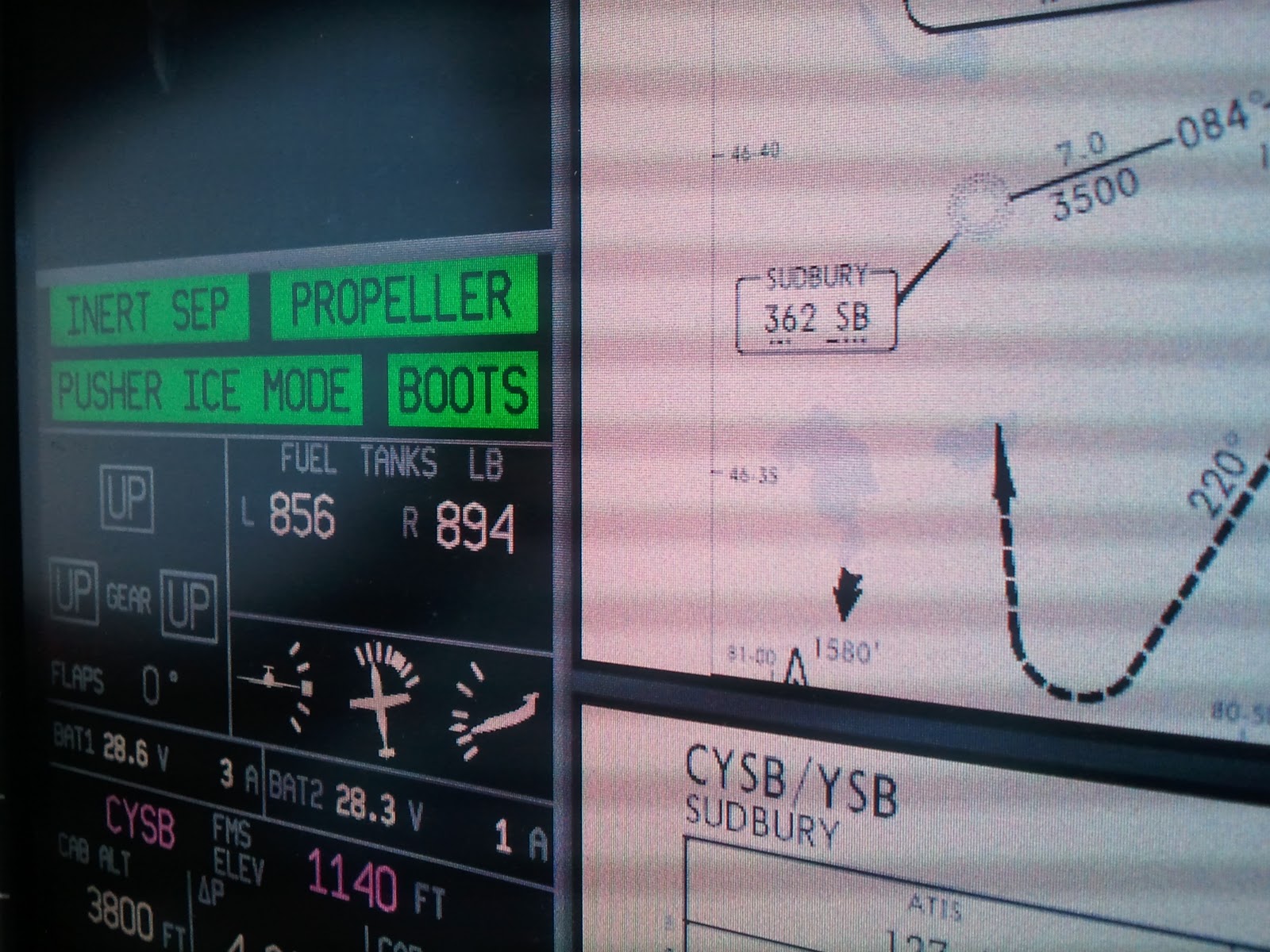
A recent example of what the aircraft is capable of would be my last recurrent training ride. It always starts with the push of a button – the automated system taking it from there, starting up electrical systems one after the other in sequence when the engine parameters reached their pre-set values.  The goal of the flight: test our capability to handle the aircraft – both in technical flying exercises as well as IFR procedures. Piece of cake! As we roll out from our hangar and start our taxi, the tasks are divided into configuring the aircraft for take-off and setting up the ‘FMS’. A wrong flaps or condition lever setting will own you a vocal warning from the aircraft: a loud ‘NO TAKE-OFF’ for all  to hear in the aircraft, making sure you will be so  embarrassed that you won’t miss it next time! The FMS incorporates all the legs of the flight, allowing the pilot to enter everything from the departure runway, SID, enroute airways, STAR and approach. Once all the information is in, it calculates a vertical profile and announces forecasted fuel consumption.

“Radio, Pulse 101 on the roll, Runway 03”. With that announcement, and all the checks complete, the last thing left to do is set the power. The PC-12NG boasts 1600 SHP, de-rated to 1200 SHP. You can definitely tell it yearns to fly. “Set Take-Off Power” the captain calls. “Take-Off Power Set” I answer.  Picture me jumping around in my seat with ELEVATION by U2 rocking in my head. It never fails. With that, I call “Positive Rate of Climb” and “Gear Up”. We are in business!

Quickly reaching our cruise altitude for today – a cozy 16,000 feet – we setup in cruise and prepare for some technical flying prowess. Ok I may be exaggerating. The airplane deserves most of the praises here, as the exquisitely crafted ailerons and trims take care of perfectly balancing the flight controls in the pilot’s hands. Only smooth movements are required as we roll through steep turns, stalls, and finally simulated engine out procedures.  Now onto the fun part!

Rapidly approaching the airport once more, we request an ILS approach, followed by an overshoot and a transition into another approach. Darn! As we near the beginning of the first approach, we get reminded that we also need to complete a holding procedure. No worries, the FMS has it all under control! Entering our first approach into the FMS and loading up the electronic approach plate that goes with it, the captain and me make a quick work of briefing and finally starting the approach. “Minimums – NO Contact” I announce once we reach our simulated minimum altitude. With the simple push of the “Go-Around” button, the Captain switches the FMS onto its overshoot procedure, synchronizing navigation and altitude constraints to reflect the new flight path already loaded. Smoothly applying full power once more, we climb out with no more to do than let ATC know we are back with them  for the next approach.

We still have to complete a holding procedure. But where? The airplane does not care, as it can enter a hold virtually anywhere, from any direction, by itself. So the task falls on me to decide as it’s going to be my approach. “Let’s ask ATC for a hold at our FAF, following the DME-ARC in” I decide.  But ATC throws a wrench in our well-laid plans. “Pulse 101, there is company traffic inbound with MEDEVAC priority. Maintain present radial to intercept the DME-ARC inbound, then you are clear to hold at the FAF as published. Report established in the hold”. I must admit I lost my breath trying to read back the clearance. WHAT sort of intercept is THAT going to give us? Looking at the captain, I see the same question mark in his eyes. Time to see what this computer is capable of! Swiftly entering the full approach and DME-ARC in the FMS, I setup the airplane to intercept from our present heading. 30 seconds later, the hold is also programmed and we still have a few minutes to take a breath and finally brief the procedure. Both the captain and I sit back, and monitor as the airplane intercepts, flies the arc, then enters the hold – all on its own. Never ceases to amaze!

Finally leaving the hold for the final stretch, I ask the captain to take a quick look at the wings as we are descending through icing and good winds. The approach will be the most challenging part of the day. With the de-ice system working full time, I make my way down the localizer steadily. Because of gusty cross-winds, I brief for a slightly higher reference speed over the threshold. The airplane has advanced stall protection which is not forgiving – a stall during flare would still activate the stick-pusher, ending with a hard nose-wheel at best…

“500 Hundred” – the automated callout resonates through the cockpit, informing us of the rapidly approaching runway. “Ref plus 10” my captain calls out. The last few hundred feet give us a rocky ride as the winds push us from side to side with each gust. I flare with a low wing into the wind, waiting for contact. I feel it – ever so slightly, as the trailing-link design of our main wheels absorb most of the touch-down shock. Bringing the power to full reverse, I settle us back firmly onto the runway.  “Radio, Pulse 101 is down and clear”. Another day, another flight. One always amazing airplane! 

1.7.11

UH-72: Lakota Helicopters at CXY


UH-72 Lakota mid-flight
If you reside or work within proximity of Capital City Airport (CXY) in New Cumberland, Pennsylvania, you are sure to have seen increased helicopter activity in the local airspace.  The helicopters you're seeing are the Pennsylvania Army National Guard's UH-72 Lakotas.  The Lakotas are designed to fly light general support operations for the Nation Guard.  So, why are they flying over New Cumberland, you ask?

The helicopters are in the area as CXY was chosen as the location for the helicopter pilots training facility.  CXY was chosen for its proximity to Fort Indiantown Gap, hangar space available for the UH-72s and current use of airspace.  CXY was also chosen because Fort Indiantown Gap coult not adequately support the Lakota training mission due to limited hangar and training space and an unallocated federal appropriation, so an alternate location (CXY) was needed.  The training mission (facility) at CXY will be in place for five years, after which the plan is to move the training mission to Fort Indiantown Gap in 2016.

The pilots receiving training on the Lakotas are Army National Guard units from 53 states and territories and active Army units primarily from the National Training Center, Joint Readiness Training Center, West Point, Belvoir, and CMTC (Germany) units.  The pilots are currently training on eight aircraft and there will eventually be eighteen aircraft in the training fleet.  Training is conducted between 7 a.m. to midnight, and during the summer months it will end at 1 a.m. as the days are longer and the pilots need to train in hours of limited visibility. 

If you have comments, questions or feedback on the UH-72 Lakota training mission at Capital City Airport, please call the Pennsylvania National Guard public affairs office at (717) 861-8468.


10.3.11

Airport Life: Pilot Introduction

Harrisburg International Airport would like to introduce our next mini-series in blogging: Airport Life. This series will explore the airport community from business and leisure travelers to airport staff.


Tom Bouck, Airline Pilot
And with that, let us introduce to you retired Continental Airlines pilot and Vietnam veteran Tom Bouck. From a young age Tom knew he wanted to become a pilot. Watching airplanes fly in and out of Schenectady County Airport in upstate New York, with his grandfather, he dreamed of one day joining these aviators in the sky as he watched from the ground.


Fast-forwarding to his stint in the Marines, Tom trained as an air traffic controller. Guiding aircrafts in and out of Marine bases, he came one step closer to realizing his dreams.


After serving for our country, he studied to obtain his private and commercial pilots licenses in Arizona. But with a combination of a competitive job market and a decreased need for pilots in the 1970’s, Tom began working for the FAA as an air traffic controller.


However, in 1981 when the air traffic control strike hit airfields nationwide, Tom soon moved away from this position. With a large amount of flight hours under his belt already, Tom refocused and switched gears back to piloting and became a flight instructor.


He began his commercial piloting career with Fresno West Air in California and moved to Command Airways based out of Poughkeepsie, N.Y. for two years. In January of 1988, Tom switched to Continental Airlines, one of Harrisburg International Airport’s airline partners, where he stayed until retirement.


Tom’s first assignment with Continental was in Denver, C.O. Shortly after, he taught flight instruction on an Airbus A300 out of Los Angeles for three years. Continental then based Tom out of Hawaii. From here he flew mainly through the South Pacific, where he was able to explore such places as Australia, New Zealand, and Guam.


After two and a half years in Hawaii, Tom headed back to the mainland where he primarily flew out of Newark Airport in Newark, N.J. Some of his favorite European destinations include Madrid, Rome and Munich.


As Tom hit the age for retirement, he made his last trip as a pilot for Continental, which he chose to fly from Newark to Las Vegas, N.V. This flight was extremely special for many reasons. Tom’s wife Nanette rode proudly onboard the jet, which was only the second time she flew with Tom. When was the first you might be thinking? The two met when Tom piloted a sight-seeing tour from Pheonix, A.Z. to the Grand Canon of which Nanette was on board.


Tom’s father was also onboard the plane. The last flight signified new life for Tom and his wife, as they had recently purchased a house in Las Vegas where they currently live in the lap of retirement. Loved ones from around the country met Tom and Nanette at their new home that day to celebrate his accomplishments.


Flying has always conjured a sense of freedom for Tom. Enjoying many aspects of the job from the challenges he faced in the skies, and strategic decision making and safety planning, to being able to pilot his own journey across the globe, aviation allowed him to fulfill a life long passion.


While Tom’s period as a pilot came to an end in 2005, just five years later Continental Airlines announced a new era in business operations. Merging with United Airlines to form United Continental Holdings, Inc., these two airlines will now, together operate approximately 5,800 flights a day in 371 airports including Harrisburg International Airport.

In keeping with our Airport Life series, how do you think this will affect the future of commercial aviation namely the employees and passengers they currently serve?

26.1.11

Guest Blog: Oh Right ... a Vacation

Today we'd like to introduce the next guest blog in our new mini series: Remembering 2010 Travels. Our third guest blogger is Robert Mark, a man who wears many hats, edits the award-winning industry blog Jetwhine.com. A commercial pilot, he's also the CEO of CommAvia, an aviation marketing communications company based in Evanston, IL.

When you've spent most of your life climbing into or out of airplanes like me – I've been a pilot all my life - the adventure of jumping on one from Chicago's O'Hare for fun can get kinda lost sometimes. This year though, when my wife signed up for an August conference in San Diego, I decided it was time to throw caution to the wind, no more Mr. Boring. After the conference, we were taking THE family vacation.

All kidding aside, the idea really evolved when my wife Nancy and I realized our 16-year old daughter soon not want to travel anywhere with us. My wife is always up for a trip and this time, my daughter – a budding actress – bought the idea right away when I mentioned the first few nights would be in LA. After Los Angeles we'd head east toward the desert and the Grand Canyon then south to Sedona – where we spent our honeymoon - and finally on to Phoenix for the plane ride back home.

The trip to San Diego was easy on the airlines with plenty of options from Chicago, even though we used mileage points on American for everything. Out of Harrisburg it's US Airways through Philadelphia (PHL) or on Delta through Atlanta (ATL). We rented an SUV for the week or so we'd be gone and that truly was one of the most expensive parts of the trip – about $750. But it did offer us plenty of flexibility for sightseeing and dinners.

I've been to LA plenty of times, but never took a studio tour. We signed up for the visit to Paramount, home of Star Trek and Glee. The cost per ticket was about $40, but it was worth every penny. Tours were in groups of six maximum which offered plenty of time for wandering and asking questions. I had no idea, for instance, that this was the same place once run by Lucille Ball. Her presence – and her pictures - are everywhere on the lots. The place is also filled with memorabilia of the hundreds of stars we've come to love over the years. Much to the dismay of my daughter, the Glee studio was closed so they could await the arrival of Brittany Spears.

The trip to the desert was amazing as we sped east out of LA on I15 to connect up with I40 toward Mojave. Within an hour the mountains east of LA had become desert. Nothing prepared us though for the dust storm as we arrived in Needles on the California/Arizona state line. I thought it was a rain shower until it hit. Can't imagine how folks live there.

We made it to Williams AZ for the night where the hotel was, well, interesting to say the least. Suffice it to say that my choice of places to spend the night in Williams before making the trek to the Grand Canyon would be the railway hotel. The place is new, clean and inexpensive. Best of all, the train trip from Williams to the Canyon the next morning is an easy two-hour journey with entertainment enroute offered up by actors and musicians. Nothing quite prepared me for the grandeur of the Grand Canyon, a place I've flown over thousands of times but never actually visited up close. We had a fellow from China shoot our Christmas card photo with the canyon as a backdrop. The cafe on the east side of the canyon in the park near the railway station is awesome, although I'll be darned if I can remember the name of the place.

The next morning we headed east toward Flagstaff and then south along AZ 89 toward Sedona. Even in an SUV, the trip down the winding road from Flagstaff where the elevation is about 7,000 feet to Sedona's more comfortable 4,500 feet means an exciting trip around dozens of mountains on the way down. What's really spectacular is the road since it has no fencing along the way. Miss a turn and the trip would have ended rather abruptly. It was a toasty 90 or so in Sedona when we arrived. We headed right for the Pink Jeep Tour I remembered from 18 years earlier. Don't miss this ride out into the desert and up into the hills around Sedona. The scenery is nothing short of spectacular. I grabbed one of the Pink Jeep models to put on my desk back home. I like remembering trips when they're fun, even if I did drive most of the thousand miles we covered in our eight days together.

We all agreed this one was great as we left Sedona for Phoenix and the comfort of a real bed at the house of some friends before the airline trip back home. By next summer my daughter would be thinking about college and getting away from mom and dad. I think I already missed this vacation when I saw the Christmas cards go out a few months later. Now I can look over and smile at the Pink Jeep on my desk.
Have you spent any time vacationing on the West Coast, where would you recommend? Does Robert's post inspire you to head west?