Showing posts with label flights. Show all posts

14.3.12

Guest Blog: Air Traveling with Joyce

Today we start a brand new guest blog series regarding air traveling with a disability.  Our guest blogger today, Joyce has traveled the U.S., lived in Europe and currently resides in Lancaster County, PA with her husband and seven year old son. She became deaf late in life, and now has the delightful privilege of teaching Sign Language to young hearing children at a private school in the Harrisburg area as a Signing Time Instructor with Signing Time Academy.

Joyce, today's Guest Blogger
Today Joyce writes for fly HIA blog about her experiences traveling as a deaf woman and shares some fantastic tips that have made flying less stressful for her.

Traveling by air used to be simple when I was a child. I was only about eight years old when I first flew from Eugene, Oregon to Sacramento, California to visit my grandmother. I didn't have to worry about listening for announcements or hearing when it was time to board my flight. An airline employee came and  and escorted me onto the plane.  As an adult, I have become deaf, and traveling can be a bit daunting when flying alone, but there are are things I've learned to do to help make it less stressful and more enjoyable. 

I make it a point to tell the security people that I'm wearing hearing aids before the alert goes off when I walk through security. When I get to the boarding gate and waiting area, I make sure the gate agent knows that I can't hear, and I need to see them when they make announcements. This ensures that if I am reading or looking in another direction, they either come let me know, or they wait and catch my eye so I get the important information. I also pay attention to the flight boards so I can be aware how much time I have to get something to eat, drink, or just walk and stretch a bit.

Once on board the aircraft, I make it a point to tell the flight attendants I am deaf and they make sure I see the demonstrations what to do in case of an emergency. Some flights now also offer Closed Captioning for the in-flight films and live TV. Do be sure to let the flight attendants know you would like this feature turned on, if it is available on your flight.  Read more about it this in-flight option.

If the film showing on the flight isn't available with Captions, there is an app for that called "Subtitles", which is also great for foreign films as well. Check it out and download it before you watch the next movie.

When I started to lose greater degrees of my hearing, traveling became a stressful process for me. When I had my first overseas flight as a hearing impaired adult, I struggled trying to find my way through airports and announcements not understanding what was going on. I still remember the flight from Seattle to Copenhagen and the kind lady that was sitting next to me. She figured out early on that I was having difficulty understanding her, but she thought it was because she had a Swedish accent. She didn't know that it was because I couldn't hear her well. She was very patient. When our plane bounced onto the landing strip in Copenhagen with such a loud boom that reverberated and shook the plane, she gently patted my hand and told me it was only the ice on the runway, the plane hadn't broke in half or crashed into anything. That was about twenty one years ago, but I still remember her and her willingness to communicate despite the "language" barrier between us. Today, I let my seat mates know right away that I'm deaf.

Don't be afraid to speak up and say, "I'm deaf" or "I'm hearing impaired" and ask them to clue you in if there are announcements you need to be aware of. If someone doesn't appear to understand what the terms "hearing impaired" or" hard of hearing" mean,  simply rephrase and say, "I don't hear well and miss a lot if I don't see what is being said." This also eliminates the possibility they may think you're being rude if you don't respond when they are talking to you. People tend to think you are ignoring them if they don't know you simply can't hear them. It also helps if you let them know that you need to see their lips if you are a speech reader, or if you prefer to use pen and paper, have that handy for them. Write that you are deaf, your name, and ask them what their name is as well. If you have a smart phone, there is an app called DragonDiction that turns speech into text. Simply have the person you're trying to communicate with speak into the phone and up comes the conversation in text.

If you let people along the way know you are either deaf or you don't hear well, it can ease a lot of the stress of air travel. Speak up and let them know.  Don't be afraid to ask for information or help with knowing what is being announced. You can meet some interesting people while flying, perhaps even make a new friend. 

If you have recently lost your hearing and would like more tips about living with hearing loss, pick up a copy of "A Survival Guide for new Deafies" by Amy Sargent. You can find out more about this wonderful book at by visit her website.

Thank you, Harrisburg International Airport, for inviting me to come on board as a guest writer for fly HIA blog. Sharing what helps us when traveling with various physical issues helps others especially first time fliers. I'm looking forward to reading the posts from your other upcoming disabled guest writers in the series.

Thank you, Joyce, for sharing your experiences with us and our readers!  Are you a deaf traveler - what tips might you have to share that compliment those offered by our guest blogger today?

25.1.12

Aircraft of our Lives: Pilatus PC-12NG

We will be running occasional posts in a guest series entitled "Aircraft of our Lives," featuring the favorite aircraft of pilots from around the globe.  Today, Jean Denis Marcellin, a professional pilot for a major Canadian operator, shares with us his love of the Pilatus PC-12NG.  Jean Denis is interested in helping make the world a better place for his fellow pilots and is passionate about aviation and all things that fly!  Enjoy today's flight on the PC-12NG. 

So the crew fly on with no thought that they are in motion. Like night over the sea, they are very far from the earth, from towns, from trees. The clock ticks on. The dials, the radio lamps, the various hands and needles go through their invisible alchemy. . . . and when the hour is at hand the pilot may glue his forehead to the window with perfect assurance. Out of oblivion the gold has been smelted: there it gleams in the lights of the airport.
— Antoine de Saint-Exupéry, 'Wind, Sand, and Stars,' 1939.

I often relate to Saint-Exupéry because flying has always had this ‘magic’ feeling for me. Maybe it was because of reading his masterpiece ‘’Le Petit Prince’’ when I was only a boy, sharing the Prince’s awe for this strange pilot and his wondrous bird. Or maybe it was just a plane love story… but I knew it was only a matter of time before I made my own way to a cockpit. And so it was that when it came time for college, I had the amazing opportunity to complete my flight training through one of Canada’s most highly regarded aviation colleges – le Centre Québécois de Formation Aéronautique (http://www.cqfa.ca).

Acquiring my CPL and Twin-IFR there during a 3-years program, I went on the International Air Rally the summer I graduated. Crossing the Quebec province from all possible angles, the 20+ airplanes involved went from Montreal to Iqualuit, ending the trip back near Quebec City. What a blast! This opened doors, created connections, and led me to my first job in Toronto, flying charter flights in a Piper Chieftain. It was a fun airplane – a real work horse – but nothing compared to what came next!

Today I fly a Pilatus PC-12NG, doing medical evacuation missions across the province of Ontario. Although it is ‘only’ a single-engine turbine, this airplane will never cease to amaze in every way.

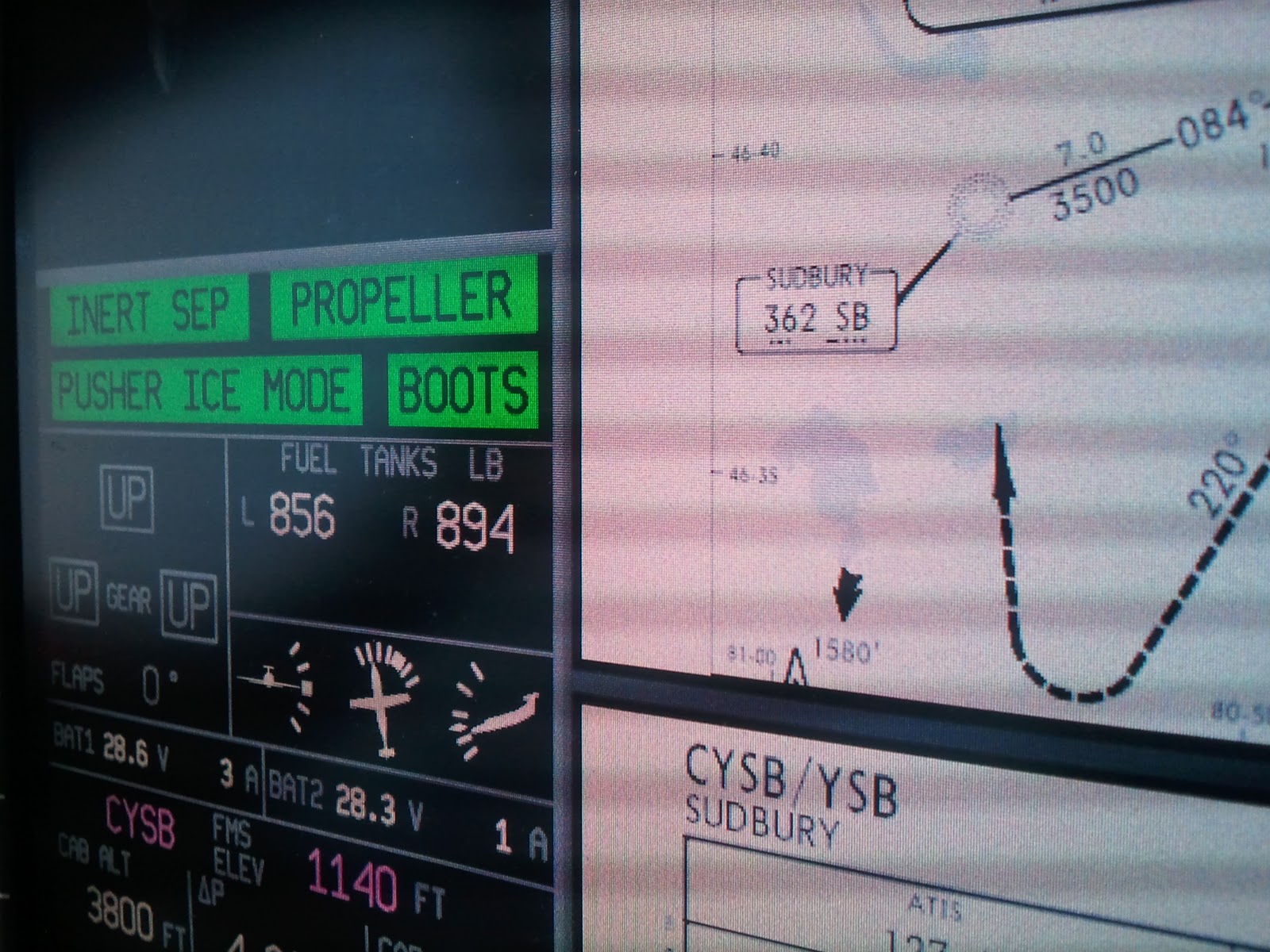
A recent example of what the aircraft is capable of would be my last recurrent training ride. It always starts with the push of a button – the automated system taking it from there, starting up electrical systems one after the other in sequence when the engine parameters reached their pre-set values.  The goal of the flight: test our capability to handle the aircraft – both in technical flying exercises as well as IFR procedures. Piece of cake! As we roll out from our hangar and start our taxi, the tasks are divided into configuring the aircraft for take-off and setting up the ‘FMS’. A wrong flaps or condition lever setting will own you a vocal warning from the aircraft: a loud ‘NO TAKE-OFF’ for all  to hear in the aircraft, making sure you will be so  embarrassed that you won’t miss it next time! The FMS incorporates all the legs of the flight, allowing the pilot to enter everything from the departure runway, SID, enroute airways, STAR and approach. Once all the information is in, it calculates a vertical profile and announces forecasted fuel consumption.

“Radio, Pulse 101 on the roll, Runway 03”. With that announcement, and all the checks complete, the last thing left to do is set the power. The PC-12NG boasts 1600 SHP, de-rated to 1200 SHP. You can definitely tell it yearns to fly. “Set Take-Off Power” the captain calls. “Take-Off Power Set” I answer.  Picture me jumping around in my seat with ELEVATION by U2 rocking in my head. It never fails. With that, I call “Positive Rate of Climb” and “Gear Up”. We are in business!

Quickly reaching our cruise altitude for today – a cozy 16,000 feet – we setup in cruise and prepare for some technical flying prowess. Ok I may be exaggerating. The airplane deserves most of the praises here, as the exquisitely crafted ailerons and trims take care of perfectly balancing the flight controls in the pilot’s hands. Only smooth movements are required as we roll through steep turns, stalls, and finally simulated engine out procedures.  Now onto the fun part!

Rapidly approaching the airport once more, we request an ILS approach, followed by an overshoot and a transition into another approach. Darn! As we near the beginning of the first approach, we get reminded that we also need to complete a holding procedure. No worries, the FMS has it all under control! Entering our first approach into the FMS and loading up the electronic approach plate that goes with it, the captain and me make a quick work of briefing and finally starting the approach. “Minimums – NO Contact” I announce once we reach our simulated minimum altitude. With the simple push of the “Go-Around” button, the Captain switches the FMS onto its overshoot procedure, synchronizing navigation and altitude constraints to reflect the new flight path already loaded. Smoothly applying full power once more, we climb out with no more to do than let ATC know we are back with them  for the next approach.

We still have to complete a holding procedure. But where? The airplane does not care, as it can enter a hold virtually anywhere, from any direction, by itself. So the task falls on me to decide as it’s going to be my approach. “Let’s ask ATC for a hold at our FAF, following the DME-ARC in” I decide.  But ATC throws a wrench in our well-laid plans. “Pulse 101, there is company traffic inbound with MEDEVAC priority. Maintain present radial to intercept the DME-ARC inbound, then you are clear to hold at the FAF as published. Report established in the hold”. I must admit I lost my breath trying to read back the clearance. WHAT sort of intercept is THAT going to give us? Looking at the captain, I see the same question mark in his eyes. Time to see what this computer is capable of! Swiftly entering the full approach and DME-ARC in the FMS, I setup the airplane to intercept from our present heading. 30 seconds later, the hold is also programmed and we still have a few minutes to take a breath and finally brief the procedure. Both the captain and I sit back, and monitor as the airplane intercepts, flies the arc, then enters the hold – all on its own. Never ceases to amaze!

Finally leaving the hold for the final stretch, I ask the captain to take a quick look at the wings as we are descending through icing and good winds. The approach will be the most challenging part of the day. With the de-ice system working full time, I make my way down the localizer steadily. Because of gusty cross-winds, I brief for a slightly higher reference speed over the threshold. The airplane has advanced stall protection which is not forgiving – a stall during flare would still activate the stick-pusher, ending with a hard nose-wheel at best…

“500 Hundred” – the automated callout resonates through the cockpit, informing us of the rapidly approaching runway. “Ref plus 10” my captain calls out. The last few hundred feet give us a rocky ride as the winds push us from side to side with each gust. I flare with a low wing into the wind, waiting for contact. I feel it – ever so slightly, as the trailing-link design of our main wheels absorb most of the touch-down shock. Bringing the power to full reverse, I settle us back firmly onto the runway.  “Radio, Pulse 101 is down and clear”. Another day, another flight. One always amazing airplane! 

25.5.11

How to Rebook Your Flight

In the summer months when severe weather (thunder storms, hail, hurricanes, tornadoes, etc) is rampant, the likelihood that your flight is delayed and/or canceled, unfortunately increases.  So in our pursuit to keep you "in the know," we went in search of some of the best flight rebooking tips we could find.  Our search landed us on this insightful "how to" article from Frommer's and from it we extrapolated the following section on how to expediently rebook your canceled flight. 

Airlines will always recommend calling their toll-free reservations number, even if wait times can be excruciatingly long and their systems risk shutting down under high call volumes. If this is the case, the best way to go is the airline's website, according to Kate Hanni, executive director of the consumer protection organization FlyersRights.org.  "You can see if you've been automatically rebooked (now a standard practice), reschedule a flight, or cancel your reservation altogether," Hanni says.

If you want face-to-face customer service, the gate or ticket agent is the traditional option. "It's a good idea to become your own information pub, says Rick Seaney, CEO of FareCompare.com.  "Sometimes the airline personnel don't know any more than you do. Get on your smartphones, laptops, or iPads, and look at airport status updates, weather reports, and flight schedules. If you help them help you, then you can get through the line faster."

A good resource for those without Internet at their fingertips is the FlyersRights.org hotline (tel. 877/359-3776). Phone operators offer travel advice in all forms: they'll look up flight availability, interpret contracts of carriage, and locate ground transportation.

Other wait-reducing tips: "Make a beeline for airport club lounges -- they have dedicated ticket agents, usually two of them," suggests travel guru and million-mile flier John DiScala of JohnnyJet.com.  Elite-status fliers can call the priority number on the back of their membership card.

Travel agents -- many with 24-hour concierge lines -- can also ease the hassle of rebooking, though not without a fee. "Agents have all the same flight information as the carriers but no line of frustrated passengers," says Jacque Salentine Busby, president of the Milwaukee-based Luxe Travel Deals. "Plus we can more readily rebook you on another carrier if necessary."

Which airlines have you had the best success in rebooking flights quickly?  What tips can you offer for rebooking that aren't addressed in this post?

6.1.10

Guest Blog: Get Rebooked Quickly & Stress Free When On A Delayed Or Cancelled Flight

We have asked a few select guest bloggers to join us on this blog as part of a six week mini series on hot button aviation topics that effect you, the traveler. These guest bloggers will no doubt enrich your travel experience by bringing in their own various perspectives and experiences from different horizons. Today we would like to introduce Steven Frischling as the first guest blogger*.

Steven, aka: Fish, and founder of The Travel Strategist, is a globe trotting photographer and recognized airline travel expert who has a knack for making sense of detailed, complex travel scenarios and understanding the intricate nature of the commercial airline industry. In the interest of sharing his in-depth knowledge of travel logistics and the intricate workings of business travel, Frischling founded the popular travel blog Flying With Fish in 2006. Flying With Fish offers regular travel tips for "Those Who Fly & Those Who Want To Fly Smarter." You can follow Steven's daily aviation and travel-related tweets on Twitter.

Today Fish will be sharing his tips on efficient and stress-free rebooking for those travelers affected by delayed/cancelled flights.

Winter is the time of year when travelers fear the weather and unfortunately are most likely to deal with unexpected delays, cancelled flights, rerouted flights and 'unforeseen' weather affecting their travel plans.

Whenever a flight is significantly delayed or cancelled there is usually a chaotic rush to be the first people in line at the gate-area counter. A planeload of passengers vying for limited amount of rebooked seats is often a slow and irritating process. This process is not only frustrating for the passengers, but the airline personnel as well. Delayed passengers tend to be angry and take their frustration out on the airline gate agents and this further slows down the process.

Should you be on a significantly delayed flight or a cancelled flight you have options to reduce your stress. Everyone wants to catch the next flight and you can increase your likelihood of a favourable rebooking while also saving yourself the irritation of standing in line only to be told "There are no more connections tonight to Portland via Detroit." So what can you do? You can always make sure you have the following information with you:

1) Always have the phone number to the airline you are flying with handy. If the airline has multiple phone numbers, find them and fly with them. The less time you spend fumbling for this basic information, the more likely you are to get yourself traveling again.

2) Know your alternate travel options for both your airline and their airline alliance partners, or code-share partners on the route you need to fly. You can get this information easily on the airline's web site, the website of their airline alliance or other online airline reservations sites. Knowing your options will save both you and the airline you are working with a lot of time and legwork.

3) Always have the itinerary of your current travel information. This information needs to include not only your intended flights, but also your PNR/Record Locator. This information is found on every airline reservation, and is emailed to you even when you book through sites such as Travelocity & Expedia.

With this information you can skip the long angry line of passengers and find a quiet place to sit down, call the airline, endure the irritating hold music and wait for an agent to rebook you on the phone. Very often agents on the phone have more options to help displaced travelers and if you are calm, polite and patient they are also often able to compensate you with a few extra frequent flyer miles if you are a member of their frequent flyer program.

Once the agent on the phone rebooks you, walk to the next gate and get ready to fly.

Happy Flying!

-Fish
http://www.flyingwithfish.com/

*The opinions expressed in this blog are not necessarily those of Harrisburg International Airport.

28.8.09

Be prepared! Fun is upon you!

Shhh! Can you keep a secret? We're going to let you in on a tidbit of information. HIA has some upcoming fun and exciting news regarding Fort Lauderdale, AirTran and freebies! That's right, we're partnering with low-fare airline, AirTran Airways and the Greater Fort Lauderdale Convention and Visitors Bureau to bring you some fun and exciting prizes and giveaways over the next eight weeks.

Be prepared for fun-in-the-sun antics at the upcoming Harrisburg Kipona Festival. It involves scuba gear and "beachy" tourists! Followed, shortly there after by an announcement in the coming days of a very exciting beach-themed giveaway! Do you want to be amongst the first to receive the giveaway info? Then sign-up today for the fly HIA e-news!

Stay tuned to www.flyHIA.com/FLL for more information!

12.5.09

Your new favorite hot spot is at 10,000 feet!

Ever have the urge to log onto your favorite airport's blog while you were cruising at 10,000 feet, but have the sudden realization that you couldn't? Well that landscape is changing as more and more airlines are adding inflight wireless internet services to their flights.

This morning, AirTran Airways announced that they will provide inflight WiFi on every flight by July 2009. AirTran is not the first to implement this amenity to its flights, click here for a list of WiFi-providing airlines.

Have you already surfed your favorite airport blog while inflight? If so, which airline were you flying at the time? Did you vote in the Every Flight effort AirTran spearheaded? We did! Our vote was for access to our blog for all AirTran passengers!