14.2.12

Aircraft of our Lives - Piper Super Cub

We will be running occasional posts in a guest series entitled "Aircraft of our Lives," featuring the favorite aircraft of pilots from around the globe.  Today, Len Costa has been piloting anything with wings, and some without, for the last 15 years all over the USA, Canada, and Mexico. He blogs about aviation technology at ThePilotReport.com in addition to hosting the Stuck Mic AvCast, an aviation podcast about Learning to Fly, Living to Fly, and Loving To Fly. For opportunities to work with Len, he can be reached via email at ThePilotReport@gmail.com.  Enjoy today's flight on the Piper Super Cub.

As a kid becoming a pilot wasn't really my thing. Nope, I had higher goals. Goals that would literally take me beyond the stratosphere and into space. Space wasn't just the final frontier, it was my frontier because for as long as I can recall and I wanted to be an astronaut.

Looking into the job postings for astronaut applicants on NASA's website made me realize that my desire to fly in space would not come to fruition. Not because I wasn't capable, but honestly because I wasn't interested. A core part of the job is to have a doctorate degree in science or mathematics and quite frankly I had no desire in those fields. Dream shattered. Or maybe not...

While I never did become an astronaut the wonder of flight didn't escape me all together. I opted for a more earthly endeavor, still flying related, when deciding to take fight lessons after experiencing my first small pane ride. It happens to be strange fortune that my family and I would be visiting the local airport one afternoon when the Experimental Aircraft Association was hosting a Young Eagles day.
Young Eagles is a program that shares the joy of aviation with children between the ages of 8 and 17 all provided by volunteer pilots in their personal aircraft. On this fateful airport visit, I would experience that; a ride in an experimental Lancair 320. With its sleek, clean lines, and Ferrari like speed, I was in love.

Following that day I began to find ways to start accumulating flight hours and taking lessons when I was 15 years old, enjoying flying so much, a career in aviation seemed natural. While I wasn't old enough to drive a car, I was flying airplanes and would end up being the only high school graduate who was an FAA certificated pilot. I had been bit by "the bug" and began pursuing all the necessary flight training requirements to become a Commercial Pilot and eventually an airline pilot.

Now most people might think that my favorite airplane to fly is the jet at work simply for the fact that it's a jet. More power, more speed, better capabilities, who couldn't love that? While I enjoy the jet, my real passion is flying general aviation aircraft. And it wasn't until recent that I could even say I had a favorite flying machine and only a trip to Alaska could show me this other world of possibilities.
My old flight student that I taught how to fly had moved onto a career in aviation as well. His dream was always to buy an airplane and live in Alaska. He succeeded! His aircraft of choice, and common fixture of the Alaskan landscape, is the Piper Super Cub; the Alaskan SUV, or super utility vehicle.

Like many Super Cubs in Alaska, this one is tricked out with a special climb propeller to produce more thrust for taking off allowing you to operate into smaller than usual landing spots. Nope, not airports, landing spots. Be it a gravel bar, mountain top, or glacier. But in order to use these off-airport locations, no stock tire would suffice. Enter the bush wheel; a large, treadless, balloon like tire that not only gives the aircraft clearance from ground objects in the bush, but also acts as a soft cushion absorbing the rough imperfections of a land-anywhere location; rocks, brush, rough terrain, just about anything.

So there I was, my first time in Alaska and excited for what flying adventures were ahead of us. Everything from landing on river gravel bars, to glaciers for camping, and even the summit of Mt Susitna where the only way in was by bush plane. You've haven't lived until you see a place you want to explore and then land, airports not required. And Alaska would be just that, the land-anywhere, do (almost) anything, aviation heaven. The place most pilots dream of.
So how does one land on a mountain top with sloping hills and no runway? Carefully. You make a few low passes first to inspect the landing area looking for debris, obstacles, whether the surface is hard enough if recent rains have passed through, in addition to determining which direction the wind is blowing to plan as normal a traffic pattern and approach to landing as one can.

And that's exactly what we did on the northeast face of Mt Susitna. Our purpose? To pick wild blueberries from the mountain top brush. No joke! So tell me, who couldn't love flying let alone in a Piper Super Cub, my favorite, highly capable, play date.

8.2.12

The Aircraft of MDT: VC-25

Welcome to the fifteenth and final regular installment of The Aircraft of MDT. In this series we have taken a look at some of the aircraft that you may spot flying to and from Harrisburg International Airport.

Boeing VC-25
SAM 28000 practicing touch-and-goes.
Note the bulge of the aerial refueling port on the
aircraft's nose.
Although the largest aircraft that flies to and from Harrisburg International Airport on a day to day basis is the A300-600F, the runway is capable of handling any plane in the world. That capacity, combined with minimal congestion and proximity to Joint Base Andrews, makes MDT the ideal spot for the president’s pilots to come practice routine maneuvers.

Often referred to as “Air Force One,” the two aircraft that serve as the primary mode of long distance transport for the President of the United States only officially bear that designation when the president is actually aboard, as does any U.S. Air Force aircraft carrying the president. Similarly, a naval aircraft carrying the president takes the call sign “Navy One,” an army aircraft, “Army One,” etc.; a civilian aircraft carrying the president is designated “Executive One.” When the president is not on board, these aircraft are typically referred to by their tail numbers: 28000 and 29000.

Officially known as the VC-25A, the presidential planes are heavily specialized modifications of the Boeing 747-200 airliner. Boeing Commercial Airplanes introduced the 747 in the late 1960s. At the time, air travel was growing in popularity and airport congestion was becoming a problem as more and more flights were added to accommodate passenger demand. To alleviate this congestion and increase their passenger load, airlines sought a jetliner larger than those currently available. Pan American Airlines collaborated heavily with Boeing on the design of the 747 and was the aircraft’s launch customer, placing an order for 25 in 1966 and taking delivery of the first plane in January of 1970. Able to carry more than 350 passengers and crew, the 747-100 was two and a half times the size of the Boeing 707, one of the most popular airliners of the era.

Boeing VC-25
SAM 28000 with Three Mile Island
in the background.
When the 747 was under development, conventional wisdom was that subsonic airliners would soon be replaced by supersonic counterparts. To guard against this eventuality, Boeing designed the 747 to be easily converted into a freighter, supposing that when passenger air travel went supersonic, subsonic aircraft could still thrive in the cargo market. The industry-wide changeover to supersonic never materialized (Boeing canceled plans for its own supersonic transport in 1971) and the 747 has proved to be very successful, with over 1400 aircraft across numerous variants delivered to date. Thirty three years after its maiden flight, production of the 747 continues with the newest variant, the 747-8.

The 747-200, launched in 1971, added more powerful engines and improved on the -100’s maximum takeoff weight. The -200 serves as the basis for the VC-25. In 1985, during the presidency of Ronald Reagan, a Request for Proposal was issued announcing the intention to replace the two 707 derived VC-137s that then served as the presidential aircraft. Both the 747 and the McDonnell Douglas DC-10 competed for the contract which ultimately went to Boeing. The VC-25s were completed the following year and first flew in 1987. After some problems with wiring the aircraft for communications, the new jets entered presidential service in 1990.
Boeing VC-25
SAM 28000 takes off again after a touch-and-go.
Both standard 747s and the VC-25s have three decks. As on a 747, the lower deck of the VC-25 is given over primarily to cargo space. The Uppermost deck houses the cockpit and the aircraft’s primary communications center. The president and other passengers ride on the main deck which is divided into several sections. The foremost section is sometimes referred to as “The White House” as it contains the president’s private state room and office. The executive suite includes a toilet, shower, double sink, and couches that convert to beds. “The Oval Office aboard Air Force One” is equipped to allow the president to address the nation while airborne, a capability that was added after President George W. Bush was forced to land in order to give such an address on September 11, 2001. The remainder of the main deck contains a conference room equipped for teleconferencing, quarters for guests, senior staff, and secret service, and seating for news media near the rear of the plane. Protocol dictates that passengers may move about freely aft of their assigned seating, but not forward of it. The aircraft has two galleys capable of serving a total of 100 people at a time. There is a medical annex aboard, complete with operating table, that is staffed by a doctor and a nurse on every flight.

Further modifications not standard on the 747 are the ability to refuel in flight, defensive countermeasures to guard against missile attack, and electronics heavily shielded against interference from the electromagnetic pulse that would result from a nuclear blast. Many of the plane's features are, of course, classified, but there is no indication that the VC-25 carries an emergency escape pod, as depicted in the 1997 film, Air Force One.

When the Request for Proposal for the VC-25 was issued, the two VC-137s were 23 and 13 years old. The VC-25s have now been in service for 22 years. Although no definite plans have been made public, a notice has been issued seeking replacements for the aircraft to enter service in 2017 and 2019. Possible candidates have included the Boeing 747-8 and 787 and the Airbus A380, although as of 2009, Airbus was no longer being considered.

Boeing VC-25
"Smoking the Mains"
As with the C-32, there is no pre-announced schedule for the VC-25’s visits to Harrisburg International Airport, but they generally occur roughly once a month. So, if you’re in our neighborhood, keep a weather eye out; watching what is, in its unique livery, one of the most recognizable aircraft in the world touch and go at MDT is a real treat.

25.1.12

The Aircraft of MDT: C-32

Welcome to the fourteenth regular installment of The Aircraft of MDT. In this series we are taking a look at some of the aircraft that you may spot flying to and from Harrisburg International Airport.

The Boeing 757-200, a narrow-body twinjet, entered service in 1983 as a replacement for the company’s 727 trijet airliner. The commercial passenger version of the 757-200 seats up to 234 people and has a range of about 4,500 miles. Over the years, several variants of the 757 have been introduced, including a stretched 757-300—capable of seating 289 passengers—and a freighter, the 757-200PF. The one version of the 757 that you’re likely to see at Harrisburg International Airport, however, is the specialized military variant, the C-32A.

C-32A
A C-32A comes in for a touch-and-go at MDT.
The C-32A, in its distinctive blue and white livery, may more commonly be referred to as “Air Force Two,” though it is only properly called that when the Vice President of the United States is aboard as its senior passenger. The United States Air Force acquired the first of its six C-32As in 1998. They operated four of the aircraft until 2010, when they acquired two more, both of which had previously been in service as commercial 757s.

The primary mission of the C-32A is transport of the Vice President and the First Lady. It is also sometimes used by members of the U.S. Cabinet and U.S. Congress. And, although the President’s primary aircraft is the 747-derived VC-25, he does sometimes fly in a C-32A, particularly when taking short trips, or when the destination’s airfield cannot accommodate the larger plane. All three of the most recent presidents have flown aboard a C-32A.

C-32A
Banking to perform another touch-and-go.
The aircraft’s body is that of a standard 757-200, but the interior has been specially fitted for its specialized duties. The passenger cabin of the C-32A is divided into four sections. The foremost section houses the plane’s communications center and galley, as well as a lavatory and seating for 10 passengers. The VIP stateroom is in the second section. It features two first-class passenger seats, a three-seat sofa that converts to a bed, an entertainment system, and a private lavatory. With its conference and staff facilities, the third section is the aircrafts business section. It also has seating for eight more passengers. The aftmost section consists of general seating for 32 passengers, as well as closets, lavatories, and a second galley. The plane also carries advanced communications, navigational, and safety systems.

In addition to the six C-32As operated by the U.S. Air Force’s 89th Airlift Wing, the 227th Special Operations Flight operates two C-32Bs. The B variant is similar to the A, but the interior is not laid out for VIP use. The C-32Bs typically wear an all-white livery and are believed to be used primarily by the U.S. State Department’s Foreign Emergency Support Team.


C-32A
A C-32A at MDT.
The C-32A has flown into Harrisburg as Air Force Two, that is, for the purpose of bringing the Vice President here, but it is much more commonly seen performing touch-and-go maneuvers. The flight from the C-32A’s home at Joint Base Andrews to Harrisburg International Airport only takes 10-15 minutes, so the long runway and relatively low traffic (compared to the even closer Washington area airports) make MDT a convenient location for these practice routines. There is no announced schedule for the C-32A’s visits, but if you keep your eyes peeled while you’re here, you may get lucky! 

Aircraft of our Lives: Pilatus PC-12NG

We will be running occasional posts in a guest series entitled "Aircraft of our Lives," featuring the favorite aircraft of pilots from around the globe.  Today, Jean Denis Marcellin, a professional pilot for a major Canadian operator, shares with us his love of the Pilatus PC-12NG.  Jean Denis is interested in helping make the world a better place for his fellow pilots and is passionate about aviation and all things that fly!  Enjoy today's flight on the PC-12NG. 

So the crew fly on with no thought that they are in motion. Like night over the sea, they are very far from the earth, from towns, from trees. The clock ticks on. The dials, the radio lamps, the various hands and needles go through their invisible alchemy. . . . and when the hour is at hand the pilot may glue his forehead to the window with perfect assurance. Out of oblivion the gold has been smelted: there it gleams in the lights of the airport.
— Antoine de Saint-Exupéry, 'Wind, Sand, and Stars,' 1939.

I often relate to Saint-Exupéry because flying has always had this ‘magic’ feeling for me. Maybe it was because of reading his masterpiece ‘’Le Petit Prince’’ when I was only a boy, sharing the Prince’s awe for this strange pilot and his wondrous bird. Or maybe it was just a plane love story… but I knew it was only a matter of time before I made my own way to a cockpit. And so it was that when it came time for college, I had the amazing opportunity to complete my flight training through one of Canada’s most highly regarded aviation colleges – le Centre Québécois de Formation Aéronautique (http://www.cqfa.ca).

Acquiring my CPL and Twin-IFR there during a 3-years program, I went on the International Air Rally the summer I graduated. Crossing the Quebec province from all possible angles, the 20+ airplanes involved went from Montreal to Iqualuit, ending the trip back near Quebec City. What a blast! This opened doors, created connections, and led me to my first job in Toronto, flying charter flights in a Piper Chieftain. It was a fun airplane – a real work horse – but nothing compared to what came next!

Today I fly a Pilatus PC-12NG, doing medical evacuation missions across the province of Ontario. Although it is ‘only’ a single-engine turbine, this airplane will never cease to amaze in every way.

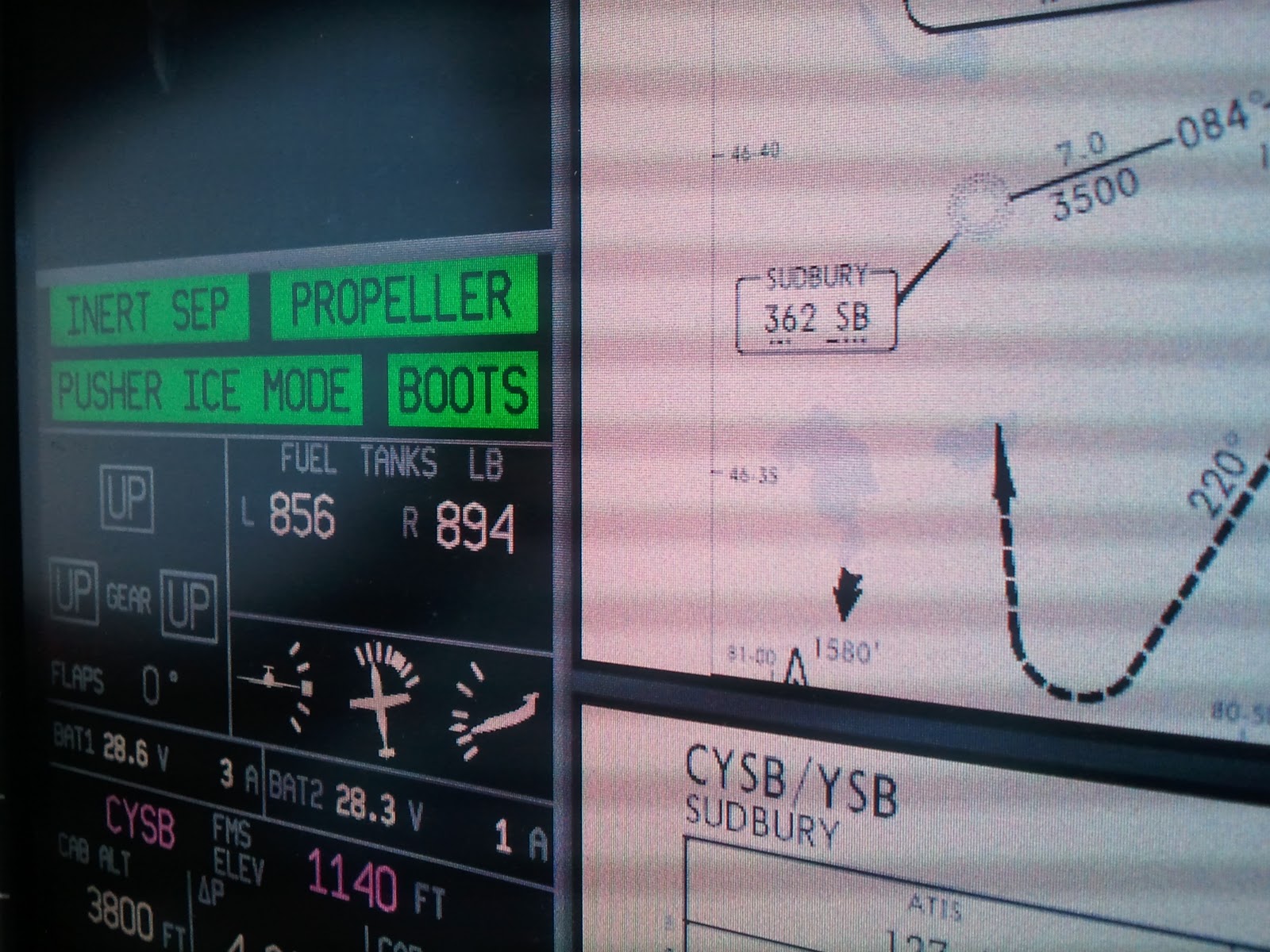
A recent example of what the aircraft is capable of would be my last recurrent training ride. It always starts with the push of a button – the automated system taking it from there, starting up electrical systems one after the other in sequence when the engine parameters reached their pre-set values.  The goal of the flight: test our capability to handle the aircraft – both in technical flying exercises as well as IFR procedures. Piece of cake! As we roll out from our hangar and start our taxi, the tasks are divided into configuring the aircraft for take-off and setting up the ‘FMS’. A wrong flaps or condition lever setting will own you a vocal warning from the aircraft: a loud ‘NO TAKE-OFF’ for all  to hear in the aircraft, making sure you will be so  embarrassed that you won’t miss it next time! The FMS incorporates all the legs of the flight, allowing the pilot to enter everything from the departure runway, SID, enroute airways, STAR and approach. Once all the information is in, it calculates a vertical profile and announces forecasted fuel consumption.

“Radio, Pulse 101 on the roll, Runway 03”. With that announcement, and all the checks complete, the last thing left to do is set the power. The PC-12NG boasts 1600 SHP, de-rated to 1200 SHP. You can definitely tell it yearns to fly. “Set Take-Off Power” the captain calls. “Take-Off Power Set” I answer.  Picture me jumping around in my seat with ELEVATION by U2 rocking in my head. It never fails. With that, I call “Positive Rate of Climb” and “Gear Up”. We are in business!

Quickly reaching our cruise altitude for today – a cozy 16,000 feet – we setup in cruise and prepare for some technical flying prowess. Ok I may be exaggerating. The airplane deserves most of the praises here, as the exquisitely crafted ailerons and trims take care of perfectly balancing the flight controls in the pilot’s hands. Only smooth movements are required as we roll through steep turns, stalls, and finally simulated engine out procedures.  Now onto the fun part!

Rapidly approaching the airport once more, we request an ILS approach, followed by an overshoot and a transition into another approach. Darn! As we near the beginning of the first approach, we get reminded that we also need to complete a holding procedure. No worries, the FMS has it all under control! Entering our first approach into the FMS and loading up the electronic approach plate that goes with it, the captain and me make a quick work of briefing and finally starting the approach. “Minimums – NO Contact” I announce once we reach our simulated minimum altitude. With the simple push of the “Go-Around” button, the Captain switches the FMS onto its overshoot procedure, synchronizing navigation and altitude constraints to reflect the new flight path already loaded. Smoothly applying full power once more, we climb out with no more to do than let ATC know we are back with them  for the next approach.

We still have to complete a holding procedure. But where? The airplane does not care, as it can enter a hold virtually anywhere, from any direction, by itself. So the task falls on me to decide as it’s going to be my approach. “Let’s ask ATC for a hold at our FAF, following the DME-ARC in” I decide.  But ATC throws a wrench in our well-laid plans. “Pulse 101, there is company traffic inbound with MEDEVAC priority. Maintain present radial to intercept the DME-ARC inbound, then you are clear to hold at the FAF as published. Report established in the hold”. I must admit I lost my breath trying to read back the clearance. WHAT sort of intercept is THAT going to give us? Looking at the captain, I see the same question mark in his eyes. Time to see what this computer is capable of! Swiftly entering the full approach and DME-ARC in the FMS, I setup the airplane to intercept from our present heading. 30 seconds later, the hold is also programmed and we still have a few minutes to take a breath and finally brief the procedure. Both the captain and I sit back, and monitor as the airplane intercepts, flies the arc, then enters the hold – all on its own. Never ceases to amaze!

Finally leaving the hold for the final stretch, I ask the captain to take a quick look at the wings as we are descending through icing and good winds. The approach will be the most challenging part of the day. With the de-ice system working full time, I make my way down the localizer steadily. Because of gusty cross-winds, I brief for a slightly higher reference speed over the threshold. The airplane has advanced stall protection which is not forgiving – a stall during flare would still activate the stick-pusher, ending with a hard nose-wheel at best…

“500 Hundred” – the automated callout resonates through the cockpit, informing us of the rapidly approaching runway. “Ref plus 10” my captain calls out. The last few hundred feet give us a rocky ride as the winds push us from side to side with each gust. I flare with a low wing into the wind, waiting for contact. I feel it – ever so slightly, as the trailing-link design of our main wheels absorb most of the touch-down shock. Bringing the power to full reverse, I settle us back firmly onto the runway.  “Radio, Pulse 101 is down and clear”. Another day, another flight. One always amazing airplane! 

19.1.12

A Plane Spotting Primer

What is plane spotting, you ask?  A hobby and past time of many who love aircraft, aviation and marvel at the wander of flight!

The key habits of the hobby:

  • Observing, spotting or watching aircraft
  • Logging the tail (registration) numbers of the aircraft spotted
  • Identifying the spotted aircraft by any number of factors: 
    • Position of Engines
    • Type of Engines
    • Distinctive Engine Sound
    • Wing Position
    • Fuselage
    • Tail Shape
    • Fixed vs. Retractable Wheels
    • And, more!
  • Photographing the aircraft, while spotting them

We, not unlike every other avid "avgeek," love to take photos when plane spotting and enjoy those of fellow plane spotters.  Here are a few of our favorites that we've snapped while spotting at MDT:
E-6B Mercury Navy AWACs
C-32a "Air Force Two"
VC-25 "Air Force One"
Did you happen to see these aircraft captures that appeared on NYC Aviation?  And, did you see this one from Airlines.net?

Where can you plane spot?  Your own backyard (if you're on an airport flight path) is a great place to start!  Some local airports (like us!) offer free observation decks to the public to enjoy - stop by and visit.  The MDT Observation Deck is open 24-hours a day to the public (there is a fee to park at MDT).
NYC Aviation has detailed plane spotting guides from some of their contributing photographers for locations in the US and UK.  

So, what's the benefit of plane spotting?  It's a fun-filled hobby a family, friends, or group can enjoy together and it's relatively inexpensive - great photos can be captured with a beginner digital camera, however avid spotters can tell you that if you're as "in" to cameras and lenses as you are the aircraft, you can amass expense with the equipment you buy to take the aircraft photos.   Beyond the time together and cool photos, the memories and the experiences are classic.  Who doesn't still find themselves marveling over the wander of flight?

Are you a plane spotter (either seasoned or amateur)?  What sparked your interest in the hobby?  Where do you enjoy the best plane spotting?  Do you have a favorite plane spotting photo?  Feel free to visit our fan page and share your favorite captures on our wall - we'd love to see them!

11.1.12

The Aircraft of MDT: C-17

Welcome to the thirteenth regular installment of The Aircraft of MDT. In this series we are taking a look at some of the aircraft that you may spot flying to and from Harrisburg International Airport.


If you look east from the terminal, you may sometimes see a C-17 Globemaster III parked on the tarmac, here in support of the operations of the Pennsylvania Air National Guard.  The C-17 is a large transport aircraft used by the United States Air Force and several international militaries to carry cargo, vehicles, and troops.
C-17
A C-17 takes off from MDT.

The McDonnell Douglas YC-15, the prototype that would eventually be developed into the C-17, was originally conceived as a replacement for the C-130 Hercules. The design competition that the YC-15 had been built for was closed down, but the U.S. Air Force soon began a new program to replace the C-141 Starlifter. McDonnell Douglas again submitted the YC-15, and the prototype was selected as the winner. The production model proved able to not only replace the aging fleet of C-141s, but also to supplement the job of the C-5 Galaxy, the U.S. Air Force’s largest aircraft.

The YC-15 prototype was built in the 1970s, and development of the C-17 proper began in the 80s. Although the first flight of the new aircraft was planned for 1990, cost overruns and design shortfalls slowed development. The first C-17 was delivered in July 1993, and the 17th Airlift Squadron, the first C-17 squadron, became operational in January 1995. To date, more than 230 C-17s have been built, and production continues at a pace of roughly 10 per year.

The cargo deck of the C-17 is 88 feet long, 18 feet wide, and 12 feet 4 inches high. It is capable of carrying tanks, helicopters, and other military vehicles. Maximum payload for the C-17 is 170,900 pounds of cargo, or 134 troops. The cargo deck can also be outfitted to serve as a medical facility. When the president travels, the presidential limousine and other motorcade vehicles are transported aboard a C-17.

C-17
A C-17 on the tarmac.
In addition to the United States Air Force, some foreign militaries also operate the C-17 (though in much smaller numbers than the U.S.). The Royal Air Force of the United Kingdom, the Royal Australian Air Force, the Royal Canadian Air Force, and the Qatar Emiri Air Force each operate fewer than 10 C-17s. There are also three C-17s in the international NATO Strategic Airlift Capability Program. As of 2010, Boeing (which acquired McDonnell Douglas in 1997) had orders from several other countries including India, South Korea, and the United Arab Emirates. Shortly after it began deliveries to the U.S. Air Force, McDonnell Douglas marketed a commercial version of the C-17. After the acquisition, Boeing continued to try to introduce the C-17 to the civilian market, but there was little interest, and no orders were ever placed, so the C-17 has remained strictly a military aircraft.

10.1.12

Disney World – Best Destination For Kids

Today we feature the guest post of Allison Sandberg.  Allison is a mother of three and loves to travel with her family. She is also a travel planner specializing in Walt Disney World, Disney Cruise Line, and Royal Caribbean Cruise Line. You can get lots of great travel advice on her website Magical Memory Planners.*

Magical Memory Planners - Allison's company.
It's not surprising that the Walt Disney World resort in Florida is one of the best destination for families. I am a mom of 3, frequent Disney traveler, and travel agent (specializing in Disney) with lots of advice for your next family trip to Disney. The best time to start planning your Disney vacation at least 6 months in advance so that you can have plenty of time to make your dining reservations 180 days in advance. Here are some tips to help you plan your next Disney vacation by deciding when to go, where to stay, deciding on your package, and other money saving tips. 

First, you must decide when you want to go. If your schedule is flexible you will find the best rates and fewest crowds during value season. For 2012, that is from January 2 - February 15 and August 5 -September 27. In addition, the fall usually offers some great deals and exciting special events such as Mickey's Not So Scarry Halloween Party. The highest prices and largest crowds are typically the weeks around Easter (the first two weeks of April in 2012).

The best price is also an important factor. A great travel agent can help you with this. I monitor all of my clients reservations and will let them know if a better price comes up. Disney is great because if a Disney promotion comes out after you book your reservation, they will allow you to modify your reservation without an additional fee. Just remember that promotions cannot be combined so you will want to use the one that saves you the most money. If you are going deluxe then a room discount may be your best deal. If you choose value or moderate then a free dining promotion may save you more. Check out more money saving tips for Disney on my website.

Once you decide when you are going the next decision is where to stay. If you have a family of 4 or less then you can stay anywhere. You just need to decide what your budget is. From value resorts to deluxe there are styles to fit every family. If you have a family of 5 or more then you can get two rooms or consider a resort that sleeps 5 or more. You may also want a villa that offers a kitchen. Don't worry about grocery shopping since you can have grocery delivery to Disney. Even if you don't have a kitchen you can save space in your luggage and save on baggage fees by having your  diapers, formula, baby food and other baby products delivered to any Disney resort with Garden Grocer.

The last step is to figure out your Magic Your Way Plan. You can decide on the type of Disney park tickets you want and if you want to add a dining plan. Dining plans can save you quite a bit on food but only if you pick the dining plan thats right for you. 

Have fun on your next Disney vacation and I recommend using a Disney Specialist Travel Planner, like myself, to help you make sure you have the best price and options for your family. When you request a free quote, I can help plan your next Disney vacation full of magical memories. Visit my website MagicalMemoryPlanners.com for more information about Disney and advice on traveling with children. 


Want to visit Disney?  Fly nonstop to Orlando from MDT on AirTran every day!  


*Publication of this blog is NOT an endorsement of Magical Memory Makers by Harrisburg International Airport (MDT). 

28.12.11

The Aircraft of MDT: KC-135 Stratotanker

Welcome to the twelfth regular installment of The Aircraft of MDT. In this series we are taking a look at some of the aircraft that you may spot flying to and from Harrisburg International Airport.

The KC-135 Stratotanker was the United States’ first jet powered tanker aircraft. Prior to its adoption in 1957, the U.S. Air Force’s primary tanker was the piston-engined KC-97 (also called the Stratotanker). The KC-97 served a vital role from the time it entered service in 1950, but it was not ideal for fueling jet aircraft. The fighters and bombers it typically served had to lower their speed and altitude in order to accommodate the relatively slow tanker. The jet-engined KC-135 solved this problem. Also, because the KC-135 operated on the same type of fuel that it was supplying to other aircraft, there was no need to keep the two supplies segregated. This change, along with its larger size, meant that the KC-135 could carry a fuel load more than three times the volume of the KC-97 (31,000+ gallons compared to 9,000 gallons).

Aft view of a KC-135. Note the boom control surfaces
extending above the tailplane.
The KC-135 Stratotanker was built by Boeing and is a sibling to their premier jetliner, the 707. The KC-135 is not a derivative of the 707; instead, both aircraft are derived from the 367-80 prototype that Boeing built in the early 50s. When the 135 was in development, it was known internally as “Model 717,” a designation that would later be used publically for the airliner that started life as the McDonnell Douglas MD-95.

The KC-135 Stratotanker employs a “flying boom” fueling system. This system uses a rigid boom that is lowered from the aft center of the tanker. The boom has flight control surfaces near its tip that allow it to be maneuvered by an operator aboard the tanker. Watching from a small window, the boom operator steadies the boom and extends it to mate with a receptacle on the receiver aircraft. Not all aircraft fit for aerial refueling are equipped for a flying boom system. The most common alternative system is the “probe and drogue,” in which a flexible hose with a cone-shaped drogue is lowered from the tanker, and the receiver aircraft positions itself to insert an extended probe. The boom on the KC-135 can be fitted with a drogue adapter that allows it to refuel aircraft of this type. In addition, some KC-135s have been outfitted with under-the-wing drogue refueling pods.

The KC-135 carries more than just fuel, too. It has an upper deck that can be outfitted to carry up to 83,000 pounds of passengers and cargo, depending on the fuel load. KC-135s have also been used by NASA. They have served as a platform in various research endeavors, and, until it was replaced in 2004, the KC-135 (minus the tanker equipment) functioned as NASA’s infamous “Vomit Comet.” Flown in parabolic arcs, the plane simulated weightlessness for astronaut trainees. One of the specially modified tankers was used to film scenes of weightlessness for the movie Apollo 13.


A KC-135 conducting touch-and-go maneuvers at MDT.
A total of 732 KC-135s have served the United States Air Force since 1957. That record makes it one of only six fixed-wing military aircraft (including the C-130) to have served for more than 50 years with their original operator. It is estimated that the fleet of KC-135s could potentially continue flying until 2040, but, since some of the aircraft would be more than 80 years old at that point, the Air Force has initiated a plan to replace them much sooner. In February 2011, a tanker based on the Boeing 767 was selected to fill the role of the 135. The new tanker, called the KC-46, is scheduled to enter service in 2017.

20.12.11

Your Turn - Parking Feedback

We're continuously pursuing what's important to our customers in their airport experience at Harrisburg International Airport.  This translates into making sure we have the amenities that are important to you!

Parking Garage at MDT
Would you mind taking a few minutes to share your thoughts on our onsite parking facilities by completing a short survey?  Your feedback would be invaluable to us!

MDT's Parking Questionnaire

Again, we thank you for your time and feedback and we look forward to seeing you in the coming days, weeks and months at MDT!  Speaking of customer amenities, are you a member of our airport loyalty program?  Check out Flyer Rewards before the next time you fly to/from MDT!

Many wishes for a safe and happy holiday season as we all travel to see our friends, family and loved ones this time of year.

14.12.11

The Aircraft of MDT: A-10 Thunderbolt II

Welcome to the eleventh regular installment of The Aircraft of MDT. In this series we are taking a look at some of the aircraft that you may spot flying to and from Harrisburg International Airport.

Although the only military aircraft with a permanent home at Harrisburg International Airport is the EC-130J, others are still a common sight. Several factors contribute to the preponderance of military air traffic at MDT: the size of the runway, the presence of the Pennsylvania Air National Guard base, and proximity to Joint Base Andrews. Some military craft come with business at the Guard base, but most come to practice “touch-and-go” maneuvers, in which the plane begins a landing, but then takes off again without ever coming to a complete stop.

One of the military aircraft you may see on the ground or in the sky around MDT is the Fairchild-Republic A-10 Thunderbolt II “Warthog.” The A-10 is a twin-engine, single seat jet used by the United States Air Force for close air support, attacking ground targets in support of nearby troops.

An A-10 Thunderbolt II parked at MDT
Named for the World War II era P-47 Thunderbolt, a fighter that served in a close air support role, the A-10 Thunderbolt II is the first U.S. Air Force aircraft designed and built solely for CAS. The USAF began planning for a new attack aircraft in the mid 1960s. By the early 70s, there were two prototypes competing to be that aircraft, the Northrup YA-9A and the Fairchild-Republic YA-10A. Ultimately, the Fairchild-Republic design won the contract, and production of the A-10 began shortly thereafter. The Air Force received its first A-10 in 1976 and 714 more over the ensuing eight years.

The A-10 can carry a wide variety and large quantity of air-to-ground and air-to-air weaponry, but its primary armament is the 19 foot long 30mm GAU-8 Avenger rotary cannon. The GAU-8 weighs in excess of 4,000 pounds when fully loaded and fires at a rate of 3,900 rounds per minute. When fired from 4,000 feet, 80% of the rounds fired from the GAU-8 will strike within a 40-foot diameter circle. The Avenger cannon was developed for the A-10, and the A-10 is still the only aircraft that carries it.

Its close air support role demands that the A-10 fly in hostile territory at relatively slow speeds and low altitudes. As such, it is built to be extraordinarily hardy. The cockpit is surrounded by a 1,200 pound “bathtub” of titanium armor to protect the pilot from projectile weapons. All of the A-10’s fuel tanks are self-sealing, protected by fire-retardant foam, and designed to be isolated from the rest of the fuel system in the event of damage. All of the aircraft’s flight systems have redundant hydraulic backups and mechanical systems to fall back on in case both the primary and secondary hydraulic systems are disabled. In a worst-case scenario, the A-10 is designed to be flyable even when missing one engine, one elevator, one tail, and half of one wing.


One of the A-10s most distinctive features is its aft section, with its large engines and twin-tail configuration. With the engines placed high off the ground and behind the wing, the chance of foreign object damage is reduced when operating from damaged or otherwise sub-standard runways. The engine placement also supports faster turn-around time in combat. The wings on the A-10 are closer to the ground than they would be if the engines were mounted underneath them, making them more accessible to ground crews. Also, because the engines are out of the way, they can be left running while the aircraft is serviced and rearmed. The twin-tail also provides dual benefits. The most obvious is redundancy, but channeling the engines’ exhaust over the tail planes and between the vertical stabilizers reduces the A-10s infrared signature, making it harder to hit with surface-to-air heat-seeking missles.